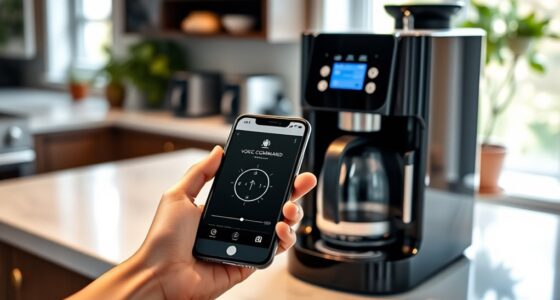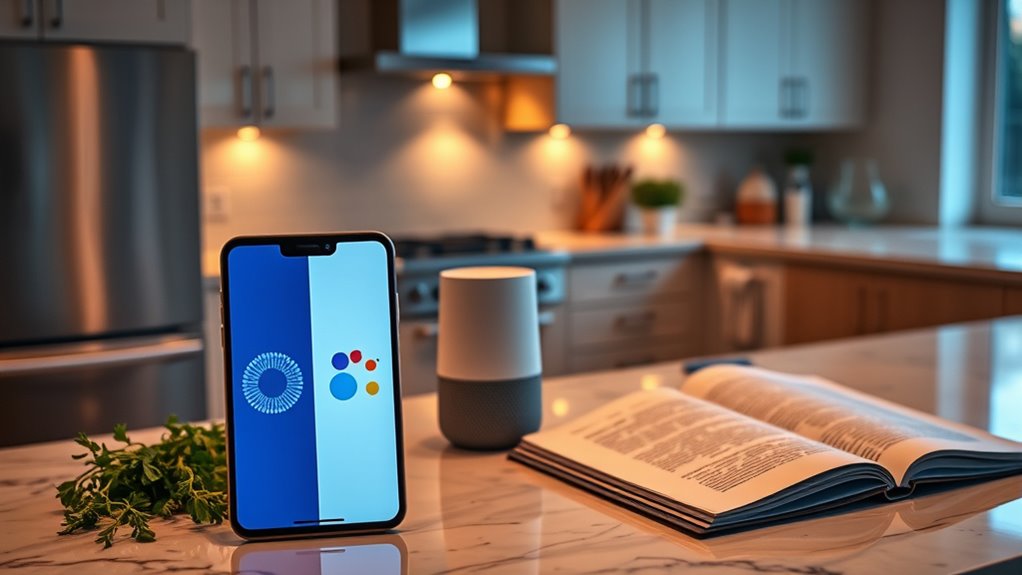

In the kitchen, Google Assistant often responds faster and understands your commands better, making it great for quick questions and step-by-step recipe guidance. Alexa offers broader device compatibility, so it might be better if you have a variety of smart gadgets. Both are easy to use and secure, but Google’s better contextual understanding gives it an edge. Continue exploring to find out which smart assistant suits your cooking style best.
Key Takeaways
- Google Assistant offers faster responses and better understanding of complex kitchen commands.
- Alexa supports a wider range of smart kitchen devices and appliances.
- Google Assistant provides more detailed recipe guidance with visual aids and tutorials.
- Alexa’s simple interface may be easier for quick, straightforward kitchen tasks.
- Privacy controls are more granular with Google Assistant, allowing easier management of voice data.

Amazon Echo Show 15 (newest model), Full HD 15.6" kitchen hub for home organization, with built-in Fire TV, Designed for Alexa+
MEET THE ALL-NEW ECHO SHOW 15 – A stunning 15.6" Full-HD (1080p) smart display that's perfect for your…
As an affiliate, we earn on qualifying purchases.
As an affiliate, we earn on qualifying purchases.
Voice Recognition and Responsiveness in the Kitchen
When it comes to voice recognition and responsiveness in the kitchen, both Alexa and Google Assistant have made significant improvements, but they still differ in key ways. You’ll notice that voice clarity is generally high with both, allowing you to speak naturally without raising your voice. However, response speed varies; Google Assistant often responds faster, giving you quicker answers and commands. Alexa’s recognition accuracy has improved, but it sometimes struggles with complex or background noise, affecting response times. Conversely, Google Assistant tends to understand context better, leading to more precise responses. In busy kitchen environments, these differences become more apparent. Overall, both are reliable, but Google’s faster response speed and slightly better voice clarity give it an edge for seamless, hands-free use. Studies on voice recognition indicate that both systems continue to evolve, but Google currently maintains a slight advantage in real-world scenarios. Additionally, ongoing technology advancements are expected to further close this gap in the future, especially as speech processing continues to improve. As research in natural language understanding progresses, we can anticipate even more accurate and responsive voice assistants tailored for the dynamic kitchen setting. Moreover, user experience plays a crucial role in how effectively these devices adapt to your specific needs and environment.

Google Nest Mini Bluetooth Speaker, Japan Model, Multi Language with English Compatibility Assistant (2nd Gen) Charcoal (Renewed)
Enhanced Audio Quality: Delve into expansive, deeper sound with added bass, perfect for enjoying hits on Spotify, YouTube…
As an affiliate, we earn on qualifying purchases.
As an affiliate, we earn on qualifying purchases.
Compatibility With Smart Home Devices and Kitchen Gadgets
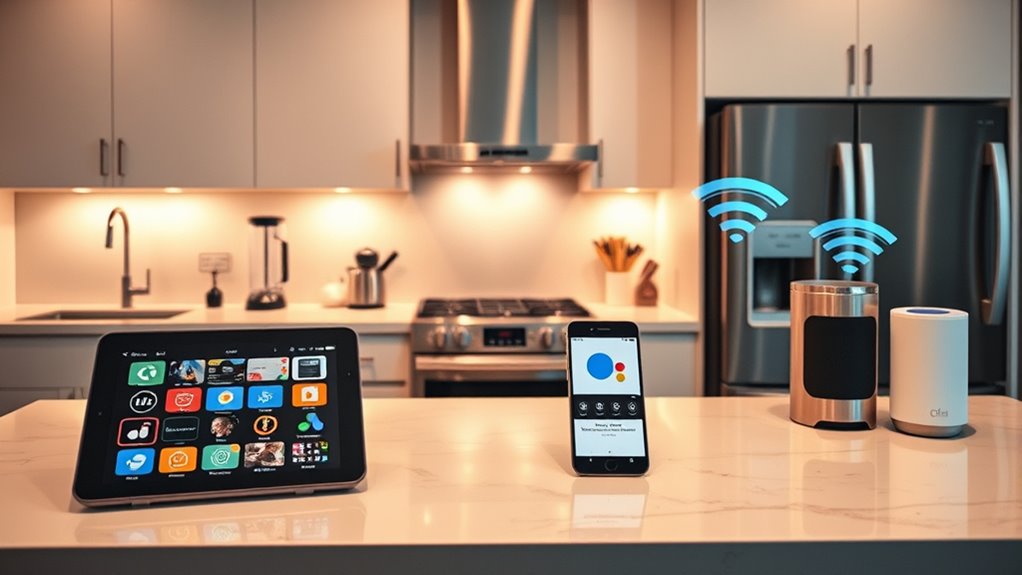
Both Alexa and Google Assistant offer extensive compatibility with smart home devices and kitchen gadgets, but they differ in breadth and ease of integration. Alexa generally has broader smart device integration, supporting a wide range of brands and models, making it easier to connect various gadgets. Its ecosystem is well-established, giving you more options for smart lights, plugs, and appliances. smart device compatibility continues to grow rapidly, ensuring both assistants remain viable choices for a connected kitchen. Setting up and controlling your smart devices is straightforward with either assistant, but Alexa’s extensive gadget compatibility might give you more flexibility if you own diverse smart home products. Additionally, ecosystem integration can influence how smoothly your devices work together, impacting your overall smart home experience. Having a unified voice assistant platform can streamline your kitchen automation and control. Furthermore, choosing the right assistant can depend on the brand preferences you have for your smart devices, as some brands may prioritize one ecosystem over the other. Considering the market share of each assistant can also help determine which might be more widely supported in future updates and new device releases. Ultimately, your choice depends on the brands you prefer and your existing smart home setup.
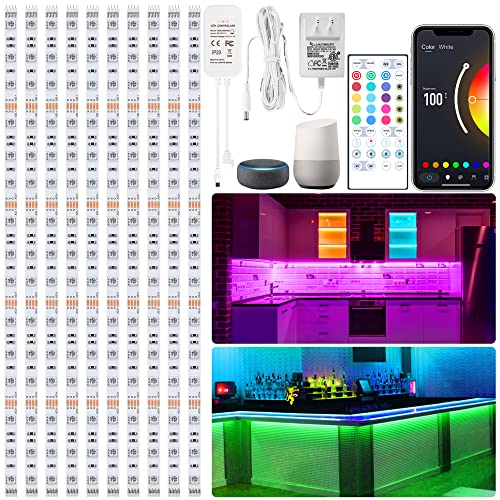
maylit 10 PCS Smart RGB Under Cabinet Lights Kit, Compatible with Alexa and Google Assistant, App and Remote Control, Music Sync Color Changing, Timer, Dimmable, for Cabinet, Counter, Shelf, Bookcase
Voice Control: Hands-free Alexa and Google Assistant voice commands to control lights on and off, change colors, adjust…
As an affiliate, we earn on qualifying purchases.
As an affiliate, we earn on qualifying purchases.
Recipe Assistance and Cooking Guidance

If you need help in the kitchen, both Alexa and Google Assistant can be valuable cooking companions. They provide recipe assistance with impressive recipe accuracy, guiding you through complex dishes step-by-step. You can ask either device for recipes, and they’ll suggest ingredient substitutions if you’re missing something. Google Assistant often offers more detailed cooking guidance, including video tutorials and visual instructions on compatible screens, making it easier to follow along. Alexa, on the other hand, excels at providing quick recipe ideas and ingredient suggestions on demand. Both assistants can set timers, convert measurements, and answer cooking questions instantly. Additionally, AI-driven recipe personalization can help tailor meal suggestions to your preferences and dietary needs. Overall, they help streamline your cooking process, giving you reliable guidance and ingredient ideas right when you need them. home décor inspiration can be a great addition to your kitchen to make it more functional and stylish.

AI Voice Recorder, Note Taking Device, Transcribe & Summarize, Voice Recorder With Display, App Control, Supports 132+ Languages, 100H, 64GB, Magnetic Audio Recorder for Lectures Meetings Calls, Black
AI-Powered Transcription & Summarization: AI Voice Recorder Powered by cutting-edge GPT-4.1 intelligence, this tool delivers real-time, highly accurate…
As an affiliate, we earn on qualifying purchases.
As an affiliate, we earn on qualifying purchases.
Ease of Use and User Interface
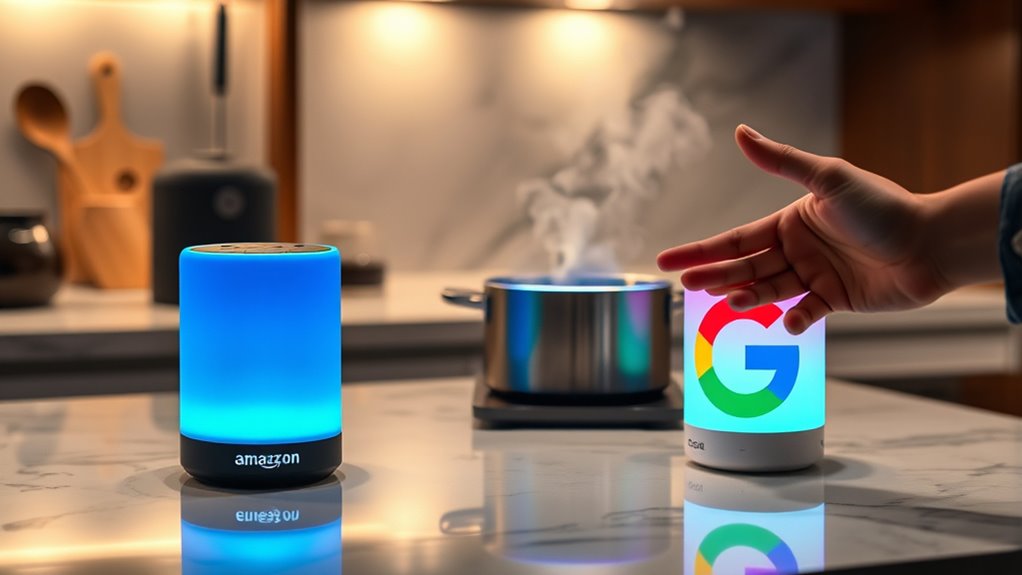
Exploring the user interfaces of Alexa and Google Assistant reveals distinct strengths that impact ease of use. Alexa’s interface design is straightforward, making commands intuitive, especially when you’re multitasking in the kitchen. Its voice clarity ensures your requests are accurately interpreted, reducing frustration. Google Assistant’s interface feels more integrated with Google’s ecosystem, offering quick access to relevant information and seamless control over compatible devices. Its voice clarity is also impressive, allowing you to speak naturally without raising your voice. Both platforms respond promptly, but Alexa’s simple design may appeal if you prefer a minimal learning curve. Additionally, environmental considerations such as minimizing disruptions and ensuring safe operation are important for kitchen use. Overall, your experience depends on how you prioritize interface simplicity versus integration, but both voice assistants aim to make kitchen tasks as effortless as possible.
Privacy and Data Security Considerations

As you consider the user-friendly interfaces of Alexa and Google Assistant, it’s also important to examine how each platform handles your privacy and data security. Both prioritize data encryption to protect your information during transmission, but their approaches to user privacy differ. Alexa records voice commands and stores them in the cloud, which may raise concerns about data retention. Google Assistant also collects voice data, but offers more granular privacy controls, allowing you to delete recordings easily. To safeguard your privacy, consider these key points:
- Review privacy settings regularly and manage voice data actively.
- Understand how data encryption keeps your information secure.
- Be aware of each platform’s policies on user privacy and data sharing.
- Vetted sources confirm that ongoing updates and transparency efforts help users stay informed about how their data is handled.
- You can also adjust privacy controls to better suit your comfort level with data sharing.
- Maintaining awareness of privacy policies ensures you are informed about data practices and any potential changes.
- Implementing energetic alignment practices can further enhance your sense of security and control over your data.
- Staying informed about privacy updates can help you adapt your settings as policies evolve.
Choosing the right assistant means balancing convenience with your privacy preferences.
Frequently Asked Questions
Can Both Assistants Operate Offline in the Kitchen?
Both assistants have limited offline functionality in the kitchen, meaning you can’t access full features without internet. However, some basic commands like controlling connected devices or setting timers might work offline. They also offer multilingual capabilities, allowing you to switch languages easily, which is handy if you’re bilingual. Keep in mind, for most advanced features and accurate responses, a steady internet connection is essential.
Which Assistant Offers Better Multilingual Support for Diverse Households?
You’ll find that Google Assistant offers better multilingual support for diverse households. Its multilingual capabilities allow you to speak in multiple languages without switching settings, making communication seamless. You can enable language switching, so it understands and responds in your preferred languages naturally. Alexa’s multilingual features are more limited, often requiring manual language changes. If fluid language switching is essential, Google Assistant provides a more flexible, user-friendly experience in multilingual households.
How Do Updates and New Features Differ Between Alexa and Google Assistant?
You’ll notice that Alexa and Google Assistant differ in how they handle software updates and feature rollout. Alexa generally receives updates through regular software updates, often introducing new skills and improvements seamlessly. Google Assistant tends to roll out new features gradually, sometimes testing them in phases before full release. Both platforms aim to improve user experience, but your preference may depend on how quickly you want access to the latest features.
Are There Differences in How Each Assistant Handles Voice Commands for Multiple Users?
You’ll notice that Google Assistant handles multiple users better with its advanced multi-user recognition and voice profile management. It can distinguish between household members, providing personalized responses and content. Alexa also offers voice profiles, but Google’s system is more seamless and accurate in recognizing individual voices, making it easier to manage multiple users in the kitchen. This creates a more tailored experience for everyone using the device.
Which Device Ecosystem Integrates Better With Kitchen Appliances?
You’ll find that Google Assistant’s ecosystem integrates better with kitchen appliances due to its broader device compatibility. It seamlessly connects with smart ovens, refrigerators, and other IoT devices, making your kitchen smarter. Alexa also offers solid ecosystem integration, but Google’s open platform supports a wider range of brands and device compatibility, giving you more control and flexibility. This makes Google Assistant a better choice for a fully integrated kitchen experience.
Conclusion
Ultimately, choosing between Alexa and Google Assistant is like picking a trusted kitchen partner—you’ll want one that responds swiftly, understands your needs, and keeps your secrets safe. Alexa may be your reliable sous-chef for smart gadgets, while Google’s recipe guidance can turn your kitchen into a culinary stage. Whichever you choose, remember it’s about creating a seamless dance in your kitchen, making every meal prep feel like a well-choreographed masterpiece.