Automated stirring with robots uses precise motors and sensors to replicate expert chef techniques like twirling and pressure, ensuring consistent, high-quality dishes. It monitors food texture and temperature in real time, adjusting movements for perfect results and even distribution of flavors. This technology improves efficiency, reduces human error, and saves costs. If you want to learn how these systems can transform your cooking process and deliver restaurant-quality meals at home, stay with us.
Key Takeaways
- Automated stirring replicates expert chef techniques with millimeter accuracy, ensuring consistent texture and flavor.
- Sensors monitor food condition in real-time, dynamically adjusting movements to prevent overcooking or uneven mixing.
- Precise control improves food quality, reduces clumping, hotspots, and enhances overall dish uniformity.
- Integration with other kitchen systems allows synchronized ingredient addition, temperature management, and process optimization.
- Automation reduces manual effort, increases capacity, and maintains high standards with error-free, consistent results.
Precision and Control in Automated Stirring

Automated stirring systems achieve remarkable precision and control by combining advanced motor technology with real-time sensor feedback. You’ll notice how the motors adjust rotation speed and direction with millisecond accuracy, replicating expert chef techniques effortlessly. Mechanical arms execute stirring actions precisely, ensuring consistent movement across batches. Sensors continuously monitor food texture and movement, providing data that fine-tunes the process on the fly. This integration guarantees each stir is perfectly timed and positioned, preventing overcooking or undercooking. You can program specific stirring patterns to match different ingredients or regional styles, ensuring authenticity and consistency. By maintaining tight control over movement and timing, these systems eliminate human variability, resulting in perfectly cooked dishes every time. This combination of precision hardware and intelligent feedback makes automated stirring a game-changer. Smart home automation technologies further enhance the integration of these systems into modern kitchens, enabling seamless control and customization. Additionally, the use of advanced sensor technology allows for real-time adjustments that adapt to changing cooking conditions, ensuring optimal results. Incorporating automated control systems helps streamline meal preparation and reduces manual effort, making the cooking process more efficient and reliable. Exploring precision control in cooking devices highlights how technology elevates culinary consistency and quality, especially when combined with integrated kitchen systems for a truly connected cooking experience.
Enhancing Food Quality and Consistency

By precisely controlling stirring movements and continuously monitoring food during the cooking process, automated systems considerably enhance food quality and consistency. They replicate expert techniques, ensuring each dish meets high standards. Sensors track texture and temperature, preventing over or undercooking. Error-free recipes guarantee uniform results across batches. Consistent stirring speed and patterns eliminate human variability, resulting in predictable, high-quality dishes. Automated systems adjust in real-time, maintaining perfect ingredient integration and cooking conditions. To visualize this, consider the following:
| Ingredient | Manual Stirring | Automated Stirring |
|---|---|---|
| Texture | Variable | Consistent |
| Temperature | Unpredictable | Precise |
| Timing | Human error | Exact |
| Evenness | Inconsistent | Uniform |
| Quality | Varies | Consistent |
Furthermore, automation in cooking helps reduce the stress and fatigue often experienced during lengthy culinary tasks, making the process more manageable and enjoyable. Incorporating precision control into culinary practices ensures that every aspect of the cooking process aligns with desired standards, further elevating food quality and consistency. Additionally, utilizing powerful motors and sensors enhances the system’s ability to perform intricate stirring patterns reliably. The integration of advanced control algorithms allows for even greater accuracy and adaptability. Embracing technological advancements in kitchen automation promises ongoing improvements in culinary precision and efficiency.
Integration With Modern Cooking Processes
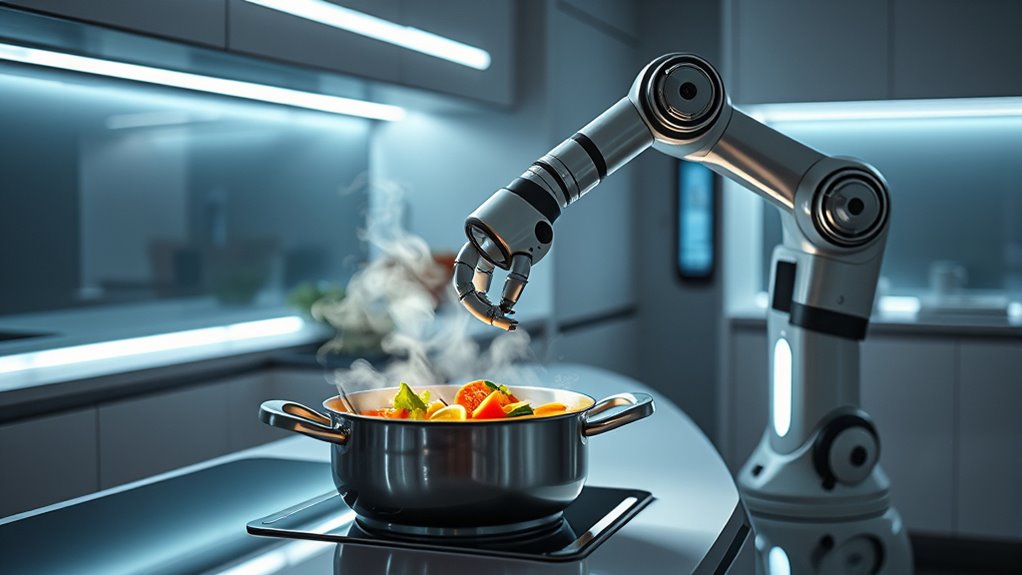
You’ll find that integrating automated stirring systems with temperature controls guarantees precise coordination between heat and movement, resulting in perfectly cooked dishes. These systems also optimize ingredient dispersion by syncing stirring patterns with ingredient addition, enhancing flavor and texture. When everything works seamlessly together, it streamlines the cooking process, reduces errors, and boosts overall efficiency. Additionally, incorporating connectivity standards allows these systems to be monitored and adjusted remotely, providing greater flexibility and control during cooking. Furthermore, implementing smart kitchen technology can facilitate real-time feedback and customization, elevating the cooking experience to new levels of cooking precision. The use of performance cookies can help gather data on how these systems are utilized, leading to continual improvements in automation capabilities.
Synchronizing Temperature and Movement
Integrating temperature regulation with stirring movements is essential for achieving consistent and high-quality results in modern robotic cooking systems. Precise synchronization ensures ingredients cook evenly, preventing burning or undercooking. Robots adjust heat levels dynamically while coordinating stirring patterns to match the dish’s requirements. This synchronization process is crucial for replicating the finesse of traditional cooking techniques. Proper color accuracy in temperature sensors and actuators further enhances control and precision during the cooking process. Additionally, implementing sensor calibration techniques ensures that temperature readings remain accurate over time, maintaining optimal cooking conditions. Maintaining cooking consistency through reliable sensor data is vital for high-quality outcomes.
Ingredient Dispersion Efficiency
Automated stirring systems enhance ingredient dispersion by precisely controlling movement patterns during cooking, ensuring even distribution of spices, sauces, and other components. You benefit from consistent mixing that prevents clumps and hotspots, delivering uniform flavor and texture. This precise control reduces the risk of uneven seasoning or ingredient separation, saving time and reducing waste. The systems adapt stirring speed and direction based on real-time sensor feedback, maximizing ingredient integration without overmixing or undermixing. Programmable patterns allow customization for different recipes, regional styles, or ingredient types, improving overall dish quality. Additionally, sensor integration enables these systems to monitor the cooking process continuously, maintaining optimal dispersion throughout. By integrating sensors and programmable routines, automated stirrers maintain ideal dispersion throughout cooking, leading to better consistency across batches and enhancing the final dish’s flavor profile. The integration of automation technology also minimizes human error, contributing to more reliable and repeatable results. Incorporating advanced control algorithms further refines the stirring process, ensuring the most efficient ingredient dispersion possible. Moreover, understanding ventilation considerations can help maintain optimal cooking environments, preventing overheating or moisture buildup.
Seamless Process Coordination
Seamless process coordination in modern cooking relies on the synchronized operation of automated stirring systems with other kitchen components, ensuring that temperature control, timing, and ingredient addition work in harmony. You’ll find these systems integrate tightly with heating elements, adjusting temperatures precisely as stirring progresses. Ingredient dispensers sync with stirring patterns to ensure even distribution at the right moments. Timing systems coordinate stirring cycles with cooking durations, preventing over- or undercooking. Automated cleaning functions activate immediately after cooking, maintaining hygiene without manual effort. Data from sensors and motors feed into AI algorithms, continuously optimizing processes. Connected equipment and real-time data monitoring are essential for maintaining consistency and avoiding errors during these complex interactions. Incorporating feedback systems helps to fine-tune operations and adapt to changing conditions in real-time. Additionally, the use of advanced automation techniques can further enhance precision and reduce manual oversight. This integration guarantees consistency, reduces errors, and enhances efficiency, allowing you to achieve restaurant-quality results with minimal manual intervention. It’s a streamlined, intelligent approach to modern culinary automation.
The Efficiency and Economic Benefits of Robotic Stirring

Robotic stirring systems markedly boost efficiency and cut costs in professional kitchens by automating a labor-intensive task. They prepare approximately 30 meals per hour, increasing throughput and reducing staffing needs. These systems handle up to 17.64 pounds of food per cycle, optimizing cooking capacity. Automated stirring eliminates manual effort, freeing staff to focus on higher-value activities like plating and quality control. The consistent movement ensures uniform cooking and ingredient distribution, minimizing waste and rework. With operational costs around $4.80 per hour, these systems considerably lower labor expenses. Their 24/7 capability boosts revenue without additional staffing. Over time, the investment recoups within three years, thanks to increased productivity, reduced waste, and steady output, making robotic stirring a cost-effective solution for modern kitchens.
Replicating Chef Techniques With Technology
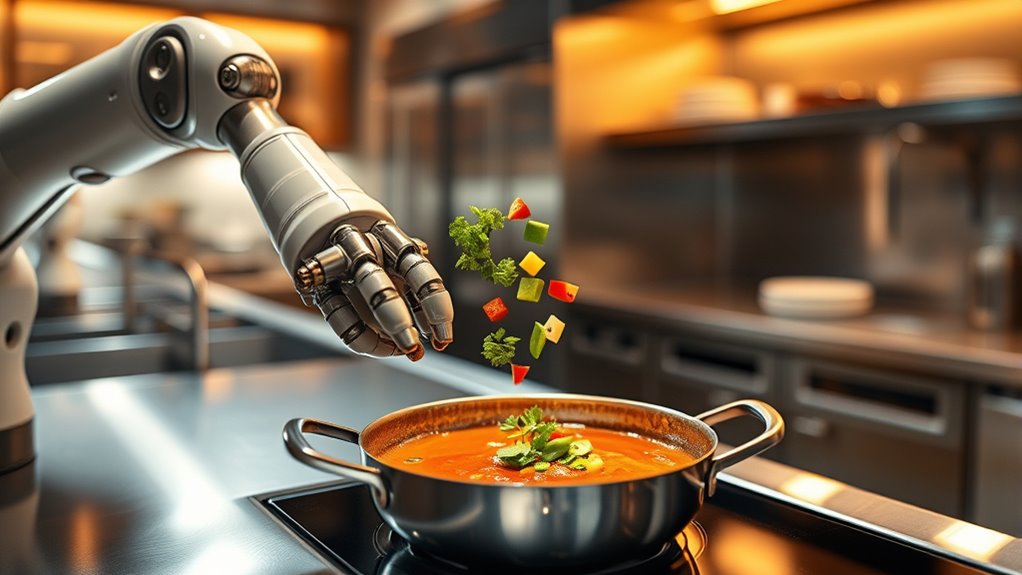
You can see how robotic systems precisely mimic expert chef movements through advanced motor control, ensuring consistent technique. Sensors track food texture and motion, allowing the robot to adapt and replicate delicate hand movements accurately. Customizable stirring patterns let you tailor techniques to regional styles or specific recipes, maintaining authentic flavors and textures.
Precise Movement Replication
Advancements in automated stirring technology enable machines to replicate the precise hand movements of expert chefs, guaranteeing consistent and authentic cooking techniques. High-resolution motors and sensors work together to imitate subtle wrist flicks, circular motions, and varying pressure. These systems analyze and reproduce movements within milliseconds, capturing the nuances that define professional stir-frying. The table below highlights key aspects of movement accuracy:
| Movement Type | Precision Level | Typical Use Case |
|---|---|---|
| Circular Stirring | ±0.5 degrees | Sauce blending, vegetable tossing |
| Back-and-Forth | ±0.2 seconds | Ingredient mixing |
| Up-and-Down | ±1 mm | Flipping, sautéing |
| Rotational Speed | ±1 RPM | Maintaining stir consistency |
| Pressure Control | ±0.1 N | Delicate ingredient handling |
This technology ensures every dish mirrors a chef’s skill, delivering authenticity with each stir.
Sensor-Driven Technique Mimicry
Sensor-driven technology elevates the capabilities of automated stirring systems by enabling machines to accurately mimic the nuanced techniques of expert chefs. You can program these systems to replicate complex stirring motions, ensuring authentic cooking results. The sensors continuously monitor food texture, movement, and temperature, providing real-time feedback. This data allows the system to modify its actions precisely. Consider these key features:
- Real-time food texture analysis ensures proper ingredient integration.
- Feedback loops optimize stirring speed and direction based on sensor input.
- Adaptive adjustments replicate subtle chef movements, like twirling or folding.
Customizable Stirring Patterns
How do automated stirring systems achieve the delicate artistry of a chef’s hand? They utilize customizable stirring patterns that replicate specific techniques from regional cuisines or individual chef styles. Through programmable settings, you can select different movement trajectories—circular, zigzag, or figure-eight—to match the desired stir-fry or sauce consistency. Sensors and motor controls precisely execute these patterns, ensuring consistent results each time. You can adjust speed, direction, and duration to suit ingredients, whether delicate herbs or thick sauces. This flexibility allows the robot to mimic expert techniques, from gentle folding to vigorous tossing. By tailoring stirring sequences, you maintain authentic flavors and textures, elevating automation from basic mixing to culinary artistry. It’s a seamless blend of technology and tradition, ensuring consistent, high-quality dishes.
Future Trends in Automated Cooking Systems
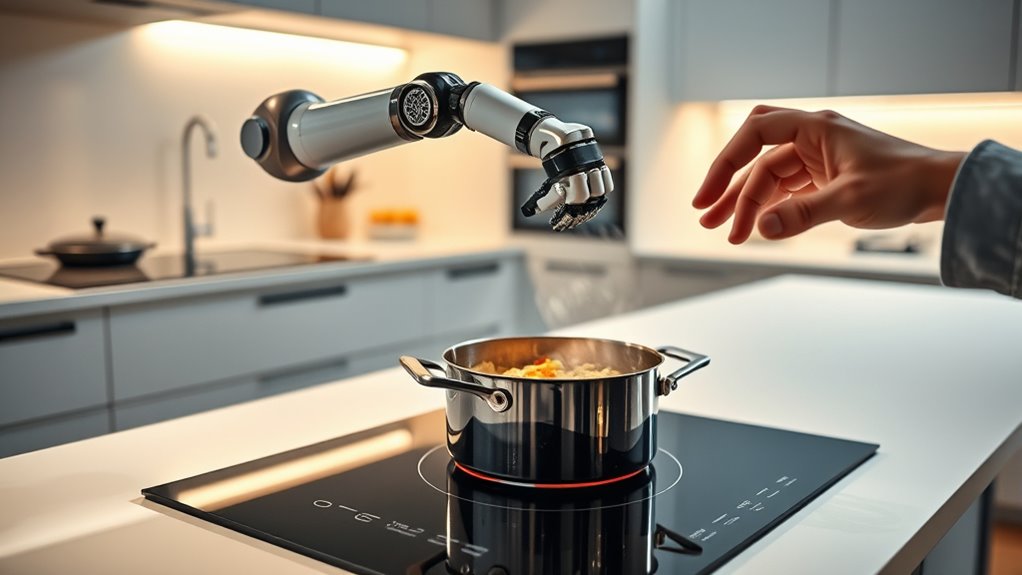
As automated cooking systems continue to evolve, we can expect them to become even more integrated with artificial intelligence and machine learning. This integration will enable systems to adapt in real-time, improving cooking accuracy and efficiency. You’ll see features like:
- Advanced AI that predicts ideal stirring patterns based on ingredient and recipe data
- Machine learning algorithms that personalize cooking processes to match individual preferences and regional styles
- Enhanced sensor networks providing real-time feedback for precise temperature, texture, and flavor adjustments
These trends will lead to smarter, more autonomous kitchens where robots not only stir but also make decisions, optimize recipes, and improve food quality continuously. The future of automated cooking promises greater consistency, customization, and efficiency for you.
Frequently Asked Questions
How Do Robotic Stirrers Adapt to Different Regional Cooking Styles?
You can program robotic stirrers to adapt to regional cooking styles by customizing stirring patterns, speeds, and directions. They use sensors and data inputs to adjust in real-time, mimicking traditional techniques. By incorporating regional ingredients and seasoning methods into the system, you guarantee authentic flavors. This flexibility allows you to serve diverse dishes consistently, honoring different culinary traditions while maintaining high quality and efficiency.
What Safety Measures Are in Place for Automated Stirring Systems?
You should know that automated stirring systems have safety measures like sensors that detect overheating and food texture issues, preventing accidents. Mechanical arms include safety stops to avoid collisions, and emergency shutoff features activate if malfunctions occur. Additionally, automatic cleaning functions minimize contamination risks. These safety features work together to ensure your cooking environment remains secure, reducing risks and providing peace of mind during operation.
Can Robotic Stirring Systems Handle Complex Multi-Ingredient Recipes?
You’ll find robotic stirring systems can handle complex multi-ingredient recipes efficiently. These systems coordinate precise movements, adjusting for texture and timing, so every ingredient gets the right attention. With sensors monitoring food during stirring, they prevent overcooking. Imagine preparing 30 meals per hour, each with multiple ingredients perfectly combined—robotic systems make this possible, ensuring consistency and accuracy even with intricate recipes.
How Easy Is It to Clean and Maintain Automated Stirring Equipment?
Cleaning and maintaining automated stirring equipment is generally straightforward. You’ll find that many systems feature automatic cleaning cycles, making routine upkeep hassle-free. Regularly inspect mechanical arms and sensors for debris or wear, and follow the manufacturer’s maintenance schedule. Keep the device dry and clean after use to prevent buildup. With simple steps, you guarantee peak performance, prolonging the lifespan of your equipment and maintaining hygiene standards effortlessly.
Are Robotic Stirrers Suitable for Home Use or Only Commercial Kitchens?
Robotic stirrers are mainly designed for commercial kitchens, but some home models are emerging. Did you know a countertop unit can prepare up to 30 meals per hour? While they offer precision, consistency, and efficiency, their size and cost still limit widespread home adoption. If you’re passionate about high-quality cooking, a home version could be useful, but currently, they’re better suited for professional settings.
Conclusion
Imagine reducing cooking time by up to 30% with robotic stirring while guaranteeing perfect consistency. By integrating automation, you can elevate your culinary creations and assure every dish meets high standards. As technology advances, automated stirring becomes more precise and accessible, transforming your kitchen. Embrace these innovations today, and enjoy the benefits of efficiency, quality, and consistency—making every meal a masterpiece with just a touch of technology.