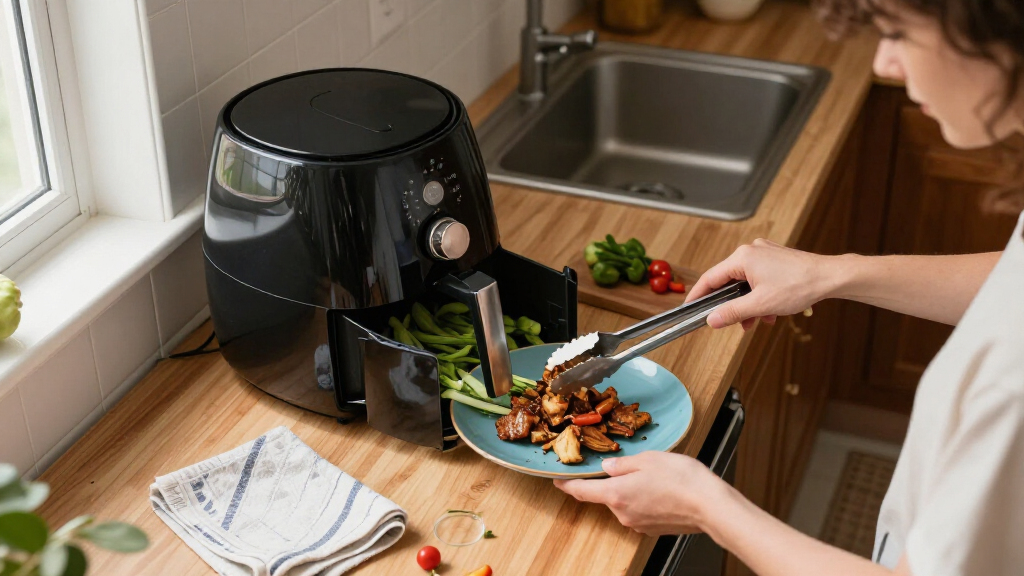
For a small kitchen, an air fryer has to justify the counter or cupboard space it takes up. The choice is often between a compact basket model, which concentrates on quick everyday cooking, and a mini-oven air fryer, which adds racks and oven-style functions at the cost of a larger footprint.

Get kitchen gear delivered free with Prime
- Fast, free delivery on millions of items
- Prime Video, Amazon Music and more included
- Member-only deals all year
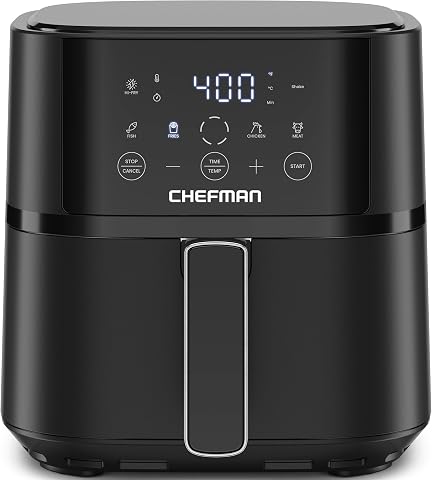
Chefman 4-Quart Compact Air Fryer
- ✔ Capacity: 4 quarts
- ✔ Power: 1500 W
- ✔ Maximum temperature: 450°F

Cosori TurboBlaze 9-in-1 Air Fryer, 6-Quart, PFAS-Free Ceramic Coating
- ✔ Capacity: 6 quarts
- ✔ Functions: 9-in-1
- ✔ Temperature range: 90°F–450°F

Chefman 2-Quart Digital Mini Air Fryer, Black
- ✔ Capacity: 2 quarts
- ✔ Power: 900 watts
- ✔ Temperature range: 95°F–400°F (listed minimum converted from 95°C in supplied specifications)
The compact basket is the easier fit for a narrow counter, a small household, or someone who wants to cook a few portions with little fuss. The mini-oven suits people who want to toast, bake, or cook different foods on separate levels, and who can spare a permanent spot for it. The real tradeoff is space efficiency versus versatility: neither form is best for every small kitchen.
At a Glance
| Criteria | Compact basket air fryer | Mini-oven air fryer | Winner |
|---|---|---|---|
| Counter space | Usually smaller and simpler to place | Larger body and more demanding placement | A |
| Cooking capacity | Best for a few portions at a time | More usable room across racks, depending on model | B |
| Cooking versatility | Focused on air frying and reheating | May add toast, bake, roast, and rack cooking | B |
| Everyday speed | Quick to load and run for small servings | More setup and preheating can offset its capacity | A |
| Batch cooking | Often needs multiple rounds for varied foods | Better suited to cooking separate items together | B |
| Cleaning | Removable basket is generally straightforward to wash | Racks and trays add parts to clean | A |
| Value | Better value if air frying is the main need | Worth the premium when extra functions replace other appliances | Depends |
Chefman 4-Quart Compact Air Fryer
The Chefman 4-Quart Compact lands in the most practical middle of this group: its stated serving size of two to four people gives us more flexibility than the 2-quart Mini, without stepping up to the Cosori’s 6-quart capacity. For a compact kitchen, that can mean fewer occasions when we need to split a meal into batches, while still avoiding the largest cooking volume in this comparison. The supplied details call it compact, though they do not include dimensions, so we should still check available counter or cabinet space before buying.Its most distinctive feature is Hi-Fry, which raises the temperature to 450°F during the final two minutes for extra crisping. That gives it a clear cooking hook the Mini lacks, and it offers high heat without the Cosori’s five fan speeds and nine cooking functions. The tradeoff is a more limited set of four presets, so buyers who want broader preset variety or finer control may prefer the Cosori. The touchscreen keeps operation direct, and the dishwasher-safe basket and rack help keep cleanup straightforward.This model makes the most sense when we want a useful everyday capacity and a defined crisping feature in a kitchen where space matters. Its 4-quart basket is still too modest for some larger households, and the Mini is easier to accommodate if meals are for one or two. Compared with the Cosori, the Chefman is the more restrained choice on capacity and controls; compared with the Mini, it is the more versatile pick for shared meals.
Pros:
- 4-quart capacity balances shared meals with a smaller cooking volume than the Cosori
- Hi-Fry setting boosts temperature to 450°F for the final two minutes
- Dishwasher-safe nonstick basket and rack simplify cleanup
- Touchscreen controls and automatic shutoff support straightforward operation
Cons:
- Four presets offer less variety than the Cosori’s nine functions
- 4-quart capacity may require batches for larger households
- No dimensions are provided, so counter and cabinet fit need checking
Best for: Small households of two to four people that want a moderate-capacity air fryer and a high-heat finish.
Not ideal for: People cooking large family batches, or buyers who need the smallest possible appliance or more than four preset functions.
Bottom line: We recommend the Chefman 4-Quart Compact as the most balanced small-kitchen choice for households that need more than a solo portion but want to avoid the largest basket here.
“We recommend the Chefman 4-Quart Compact as the most balanced small-kitchen choice for households that need more than a solo portion but want to avoid the largest basket here.”
Cosori TurboBlaze 9-in-1 Air Fryer, 6-Quart, PFAS-Free Ceramic Coating
When small-kitchen buyers still need to cook substantial meals, the Cosori TurboBlaze 6-Quart offers the most room in this lineup. Its large square basket is described as suited to family meals, making it a better fit for fuller batches than either Chefman. The cost of that capacity is physical: a 6-quart appliance may take more counter or cabinet space, so it is the least convincing option for a kitchen where every storage shelf is already spoken for.The Cosori earns its premium-capability role through nine cooking functions, five fan speeds, and a stated temperature range from 90°F to 450°F. Those controls give us more ways to tailor cooking than the 4-quart Chefman’s four presets or the Mini’s touch controls and timer-focused feature set. A customizable preheat function adds another step of control. Its ceramic-coated basket and crisper tray are dishwasher safe, like the cooking parts on both Chefman models, so cleanup does not distinguish it as strongly as its capacity and flexibility do.We would choose this model when cooking a larger batch in one go matters more than keeping the appliance small. The description also specifies operation below 53 dB and a PFAS-free ceramic coating, details that may appeal to buyers comparing materials and noise. But the 6-quart capacity is precisely the drawback for a truly tight kitchen, and shoppers seeking a modest appliance for one or two should consider the Mini instead. There is no supplied information about its external dimensions, so the basket size alone cannot confirm whether it fits a particular counter.
Pros:
- Largest stated capacity in this comparison at 6 quarts
- Nine functions and five fan speeds provide the broadest stated cooking control
- PFAS-free ceramic-coated basket and crisper tray are dishwasher safe
- Description specifies operation below 53 dB and a customizable preheat function
Cons:
- 6-quart capacity may consume more counter or cabinet space than either Chefman
- No external dimensions are provided to confirm fit
- Its larger batch capacity may be unnecessary for one- or two-person cooking
Best for: Small-kitchen households that cook family-size batches and have enough counter or cabinet room for a 6-quart appliance.
Not ideal for: One- or two-person households with tight storage, or buyers who value a smaller footprint above added capacity and cooking options.
Bottom line: We would pick the Cosori when batch capacity and control options justify making room for the largest air fryer in this comparison.
“We would pick the Cosori when batch capacity and control options justify making room for the largest air fryer in this comparison.”
Chefman 2-Quart Digital Mini Air Fryer, Black
The Chefman 2-Quart Digital Mini is the clearest choice when saving room matters more than cooking a full shared meal. Its listed dimensions are 10 × 10 × 8.3 inches and it weighs 5.9 pounds, giving us concrete fit information that the other two product descriptions do not provide. That can make it easier to plan a place for the appliance in a crowded kitchen or put it away between uses. Its capacity is designed for just one or two people, however, so a household that regularly cooks for more people will likely need to make multiple batches.Unlike the 4-quart Chefman, this Mini tops out at 400°F and does not list the Hi-Fry finishing boost. It also has a smaller 900-watt power rating, while the larger Chefman is rated at 1500 W. In return, we get a digital timer, shake reminder, and automatic shutoff in a compact package. The touch panel allows cooking time and temperature adjustments, but it does not approach the Cosori’s nine functions, five fan speeds, or 90°F–450°F range.Both Chefman models have dishwasher-safe nonstick baskets and racks, so the Mini does not ask us to trade away easy cleanup for its smaller size. Its square basket makes efficient use of the stated capacity, but two quarts remains a firm limit: this is better for snacks, sides, or individual portions than a larger dinner. We would choose it over the 4-quart model for a solo cook with very limited storage; we would choose the 4-quart instead when sharing meals or reducing batch cooking is more important.
Pros:
- Listed 10 × 10 × 8.3-inch dimensions help assess tight storage
- 5.9-pound weight makes it easier to move or put away than a larger-capacity option
- Dishwasher-safe basket and rack simplify cleanup
- Shake reminder and automatic shutoff add useful prompts and safety
Cons:
- 2-quart capacity is intended for only one or two people
- 400°F maximum is lower than the 450°F maximum on the other two models
- Small batches can mean repeated cooking for a shared meal
Best for: Solo cooks or two-person households that need a genuinely small appliance and want to store it between uses.
Not ideal for: Families, frequent batch cooks, or anyone who wants a temperature ceiling above 400°F or broad cooking presets.
Bottom line: We recommend the Chefman Mini when minimal size and easy storage matter more than cooking capacity or a broad range of functions.
“We recommend the Chefman Mini when minimal size and easy storage matter more than cooking capacity or a broad range of functions.”
As an Amazon Associate we earn from qualifying purchases.
Key Differences
In a genuinely cramped kitchen, the compact basket has the clearest practical advantage: it is generally easier to fit, move, and put away. That matters beyond appearance. If an appliance blocks a prep area or has no safe home between uses, its extra capacity can become a reason to leave it unused. The basket form also makes the cooking routine simple: add food, shake or turn it when needed, then wash one main cooking vessel.
The mini-oven earns its extra space when its layout changes how the household cooks. Racks can accommodate different foods at once, and oven-style settings may cover toast, baking, or roasting. That can reduce reliance on another countertop appliance. But rack space does not automatically mean faster meals: foods may cook unevenly across levels, and extra trays take time to clean. The better choice depends on whether that versatility will see regular use.
Capacity and value are linked to the same question: how much food do you make at once, and how many functions do you need? A small household that air fries sides or reheats leftovers is unlikely to benefit much from paying for a larger oven-style unit. Someone cooking several components together may save time and appliance space over the long run. Check the appliance’s external dimensions, clearance guidance, and the room needed to open it before buying; stated capacity alone does not tell you whether it will fit your kitchen or routine.
Detailed Comparison
Counter space (Compact basket air fryer wins — major)
Winner: compact basket, with a major advantage in the tightest kitchens. Basket models generally use a smaller, simpler footprint, while mini-ovens need room for a broader body and often require usable clearance around or above them. A few centimeters can determine whether either appliance fits beside the kettle or under a cabinet, so measure the intended spot and check the manual’s clearance requirements.
Cooking capacity (Mini-oven air fryer wins — moderate)
Winner: mini-oven, by a moderate margin for mixed or larger meals. Its rack layout can create more usable cooking area than a compact basket, though exact capacity varies widely. A basket remains adequate for a few portions, but may require back-to-back rounds for a meal with several components. For small households, unused oven capacity is not a meaningful benefit.
Cooking versatility (Mini-oven air fryer wins — major)
Winner: mini-oven, by a major margin if you use its extra settings. Rack access and functions such as toast, bake, or roast can make it serve more jobs than a focused basket fryer. The gain is limited if air frying is all you want; extra modes only justify extra cost and space when they replace tasks handled by another appliance.
Everyday speed (Compact basket air fryer wins — moderate)
Winner: compact basket, by a moderate margin for small servings. A smaller cooking chamber and direct basket access make quick portions easy to start and check. A mini-oven can cook more food at once, but its setup and preheating may erase that advantage for a single serving. For larger meals, the oven’s ability to handle multiple items can reverse the time equation.
Batch cooking (Mini-oven air fryer wins — moderate)
Winner: mini-oven, by a moderate margin. Separate racks can hold different foods at the same time, reducing the need to cook each item in a separate round. Results can vary by rack position, so some foods may need rotating or checking. A basket is simpler for one batch of one food, but less convenient when dinner includes several items with different cooking times.
Cleaning (Compact basket air fryer wins — minor)
Winner: compact basket, by a minor to moderate margin. Many models have one removable basket and crisper plate, which are relatively simple to wash. Mini-ovens add racks and trays that can catch grease and crumbs. Nonstick finishes and dishwasher guidance vary by product, so check care instructions rather than assuming every removable part is dishwasher-safe.
Value (moderate difference)
Winner: depends on how many functions you will use. The compact basket is usually the more sensible spend when air frying is the sole goal. Paying more for a mini-oven can make sense if its toast, bake, or rack-cooking functions replace appliances you already use. If the extra modes will sit idle, the purchase adds cost and occupies more room without improving everyday meals.
Compact basket air fryer: Pros and Cons
Pros:
- Smaller footprint suits crowded counters
- Straightforward for quick, small servings
- Fewer cooking parts usually mean simpler cleanup
- Often the lower-cost choice for basic air frying
Cons:
- Limited room for larger or varied meals
- May require cooking in batches
- Usually offers fewer functions beyond air frying
Mini-oven air fryer: Pros and Cons
Pros:
- Rack layout can handle several foods together
- Often adds toast, bake, or roast settings
- May replace another countertop appliance
Cons:
- Takes more counter or storage space
- More trays and racks to clean
- Extra functions may not repay the higher price if rarely used
Who Should Choose What
Choose Compact basket air fryer if:
- Your counter is very limited and you can store only a small appliance.
- You mainly cook one or two portions, sides, or reheated leftovers.
- You value quick setup and simple cleanup more than extra cooking modes.
Choose Mini-oven air fryer if:
- You regularly make meals with multiple components at once.
- You will use rack cooking and functions such as toast or baking often.
- You have measured a suitable spot and want one appliance to cover several countertop jobs.
Skip both if: Skip both if there is no safe, ventilated place for an appliance of either size, or if your household routinely needs more capacity than a compact countertop unit can provide.
Value for Money
Paying more for a mini-oven is worthwhile when its extra functions replace work you currently do with another appliance, or when cooking across racks solves a regular batch-cooking problem. In that case, the higher price buys capability and may free space elsewhere. If you mainly want crisped sides, snacks, and occasional reheating, the compact basket is better value: you avoid paying for features that do not change your routine. Compare the total footprint and usable cooking area, not just the purchase price or a capacity number in isolation.
Final Verdict
For most people choosing an air fryer specifically for a small kitchen, the compact basket is the safer recommendation. It is easier to place, simpler to clean, and well suited to the small portions that often make sense in a limited cooking space. Choose the mini-oven when you can spare the counter area and will regularly use its racks or additional oven functions. The deciding factor is not simply how much food each can hold; it is whether the mini-oven’s extra versatility earns its larger footprint in your daily routine.
Frequently Asked Questions
Which air fryer takes up less space in a small kitchen?
A compact basket air fryer usually has the smaller footprint. Compare the exact width, depth, height, and required clearance for the specific model before deciding; a compact product can still be awkward under low cabinets.
Is a mini-oven air fryer better for cooking a full meal?
It can be, especially when its racks let you cook different foods together. Check rack capacity and how foods cook at different levels. A larger chamber does not guarantee that every food will finish at the same time or cook evenly without attention.
Is the more expensive mini-oven worth it?
It is worth paying more if you will use its extra cooking modes or rack space often enough to replace another appliance or avoid repeated batches. If you mainly air fry small portions, a compact basket is usually the better value.
Which type is easier to clean?
A basket model is generally simpler because it has fewer removable parts. A mini-oven’s racks and trays add cleanup, though removable parts and care requirements differ by model.
Halloween Picks
halloween
As an affiliate, we earn on qualifying purchases.