
TL;DR
La Cucina Italiana has republished a passatelli-in-broth recipe attributed to Delia Pavoni Notari, the magazine’s founder, who included it among the classic soups in its first issue in 1929. The dish uses breadcrumbs, Parmigiano Reggiano, eggs, lemon and nutmeg; the dough is pressed through a special tool or a large-hole potato ricer and cooked briefly in broth.
La Cucina Italiana is revisiting a passatelli-in-broth recipe that founder Delia Pavoni Notari included among the classic soups in the magazine’s first issue in 1929. The recipe offers a documented link between the publication’s early food coverage and a familiar Emilia-Romagna dish made from breadcrumbs, Parmigiano Reggiano and eggs, then cooked in broth.

Get kitchen gear delivered free with Prime
- Fast, free delivery on millions of items
- Prime Video, Amazon Music and more included
- Member-only deals all year
The recipe, published by La Cucina Italiana under the title “Passatelli del Dottor Balanzone,” calls for breadcrumbs, grated Parmigiano Reggiano PDO and eggs, with nutmeg, lemon, salt and pepper for seasoning. It specifies vegetable broth for cooking and serving. Flour is not included in the listed ingredients.
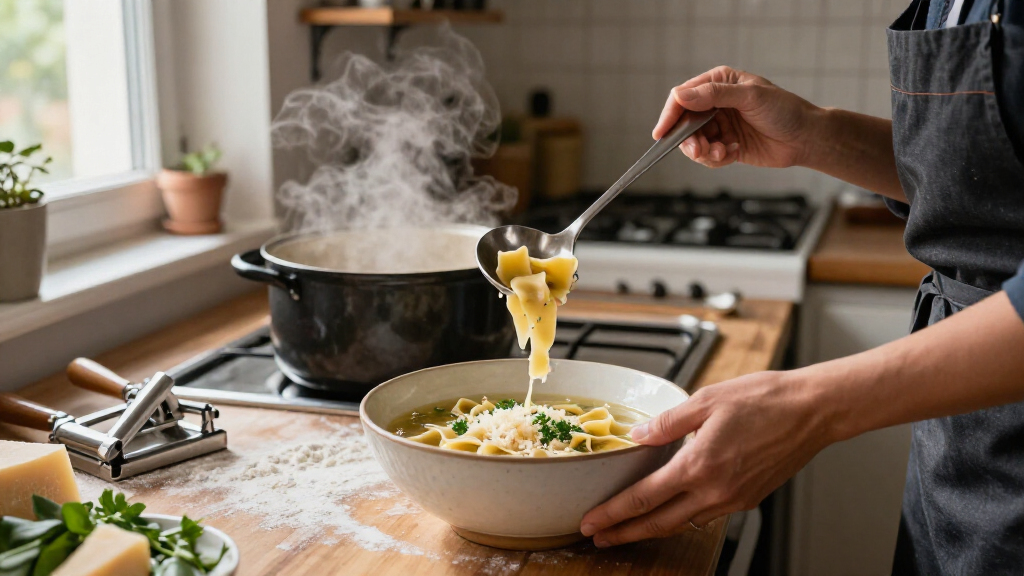
To prepare the dough, the ingredients are mixed until firm and then left to rest. The rested mixture is pushed through a passatelli tool, whose perforations form the strands, or through a potato ricer fitted with large holes. The strands cook in broth for just a few minutes, according to the source, and can be served with additional Parmesan and pepper.
The article connects the dish with Emilia-Romagna and the tool that gives passatelli their shape and name. It also frames the recipe through Delia Pavoni Notari’s role as the magazine’s founder and through Doctor Balanzone, a character from commedia dell’arte associated with Bologna. These details provide historical and cultural framing; the source does not give a date for the article’s current republication.
A Recipe Tied to the Magazine’s Origins
The recipe matters as a small piece of culinary and publishing history: it shows that a regional soup appeared in La Cucina Italiana’s first issue, rather than being presented solely as a contemporary recipe. The association with founder Delia Pavoni Notari gives the dish a specific place in the magazine’s early record.
For readers preparing the dish, the article also sets out a practical method and an alternative tool. A dedicated passatelli press is not required if a large-hole potato ricer is available. The source’s ingredient list and method distinguish this version from recipes that may use different broths or additions, while keeping the preparation straightforward: mix, rest, press and briefly cook.
The recipe’s cultural references place it within Emilia-Romagna’s food traditions and Bologna’s popular theatrical imagery. Those references help explain why the magazine presents the soup as more than a set of instructions, but the article does not claim that this is the region’s sole or definitive version.
Products Worth Considering

KitchenAid 38 oz Cold Brew Coffee Maker (KCM5912)

Vitamix VX1 Professional-Grade Blender, 64 oz, Black

Le Creuset Noël Collection Holiday Tree Round Dutch Oven, 4.5 qt, Shell Pink
As an affiliate, we earn on qualifying purchases.
The 1929 Recipe and Its Roots
Passatelli are made by pressing a firm dough through a perforated implement, producing short strands that are cooked in broth. La Cucina Italiana says the name and shape are associated with the tool used to press them. The recipe’s combination of breadcrumbs, cheese and eggs is the central base described in the source; lemon and nutmeg add seasoning.
The article traces this particular version to the magazine’s first issue, published in 1929, where Pavoni Notari included it among classic soups. It invokes the azdore, women who managed Romagnol households and whose cooking is presented as part of the dish’s tradition. It also calls Doctor Balanzone a learned commedia dell’arte character and a symbol of Bologna, using the figure as a cultural reference in the recipe’s title and introduction.
The source points readers to other preparations, including a version associated with chef Massimo Bottura, seafood passatelli, passatelli in fish broth, and chickpea passatelli with clam and tarragon broth. These are listed as related recipes, not as ingredients or steps in the 1929 preparation.
Details the Source Does Not Give
The supplied article does not state when its current presentation was published, so the timing of the present feature cannot be established from the source alone. It also does not provide exact ingredient quantities, a dough-resting duration, or a precise broth volume in the material provided here. Readers would need the full recipe instructions for those measurements.
The source identifies vegetable broth for this recipe but does not say whether it is the only broth traditionally used for passatelli. Its list of fish and seafood variations indicates that other preparations exist, but it does not provide their methods or establish how widely each version is used. The article also offers no independent historical documentation beyond its account of the recipe’s appearance in the 1929 first issue.
The Recipe’s Practical Next Steps
Readers who want to cook this version can follow the full recipe on La Cucina Italiana’s website for exact quantities and instructions. The method described in the supplied article is to combine the listed ingredients into a firm dough, let it rest, press it through a passatelli tool or large-hole potato ricer, and cook the strands briefly in vegetable broth. Parmesan and pepper are suggested for serving.
The source also directs readers to related passatelli recipes, including seafood and chickpea versions. No further announcement, new publication date or change to the recipe is given, so any developments beyond the existing recipe page remain unreported.
Key Questions
What are passatelli?
Passatelli are strands of firm dough pressed through a perforated tool and cooked in broth. The source connects the dish with Emilia-Romagna.
What ingredients does this recipe use?
The listed ingredients are breadcrumbs, grated Parmigiano Reggiano PDO, eggs, nutmeg, lemon, salt and pepper, with vegetable broth for cooking. The article says flour is not needed.
How are the strands shaped without a passatelli tool?
La Cucina Italiana says a potato ricer with large holes can be used instead of a dedicated passatelli tool.
How long do passatelli cook in broth?
The source says to cook them for just a few minutes. It does not give a precise number of minutes in the supplied material.
When did this recipe appear in La Cucina Italiana?
The publication says Delia Pavoni Notari included it among the classic soups in the magazine’s first issue in 1929.
Source: rss