Automatic bread makers range from straightforward machines for everyday loaves to feature-rich models with custom settings and specialty programs. The Zojirushi Home Bakery Virtuoso Plus is my best overall pick for buyers who want a premium, full-size machine, while the KITCHENARM 29-in-1 stands out for program variety and the Cuisinart Compact CBK-110 for a smaller footprint. The main tradeoffs are control versus simplicity, counter space versus loaf capacity, and preset convenience versus customization. Some models add features such as convection baking, automatic ingredient dispensers, or dough-focused programs, but those extras suit particular routines. Read on for the full comparison and guidance on which features are worth prioritizing.

Get kitchen gear delivered free with Prime
- Fast, free delivery on millions of items
- Prime Video, Amazon Music and more included
- Member-only deals all year
Complete the kit



Key Takeaways
The Zojirushi Virtuoso Plus and Home Bakery Supreme serve buyers who favor a full-size, premium bread-making setup; their footprint makes more sense when the machine will see regular use.
KITCHENARM’s 29 programs give it the broadest stated preset selection in this lineup, while the Panasonic SD-R2550 and Rosewill also offer many preset choices for buyers who prefer guided baking.
Convection baking is a distinct selling point of the Cuisinart CBK-210, while Breville’s Custom Loaf and KBS’s automatic nut dispenser target buyers who want more control over add-ins and baking routines.
Compactness and capacity do not always go together: the Cuisinart CBK-110 has a compact design with a stated 2-pound capacity, so check the machine’s dimensions as well as its loaf size.
Specialty dough needs change the shortlist: Cuisinart Pastafecto is the dedicated pasta and bread dough option, while standard bread makers in this group are better suited to routine loaf baking.


| automatic bread maker | Programs | Delay timer | Loaf sizes | Warranty |
|---|---|---|---|---|
| KITCHENARM 29-in-1 Smart Bread | — | Up to 15 hours | 1 lb, 1.5 lb, and 2 lb | 2 years; lifetime customer service |
| Zojirushi Home Bakery Supreme | 10 | — | — | 1 year |
| Cuisinart Convection Bread Mak | 16 | Up to 13 hours | 1 lb, 1.5 lb, and 2 lb | Limited 3-year warranty |
| Rosewill 25-in-1 Automatic Bre | 25 | Up to 15 hours | — | — |
| KBS Pro Bread Maker | 17 automatic programs and 1 custom setting | 15 hours | 1 lb, 1.5 lb, and 2.2 lb | — |
| Elite Gourmet Programmable Bre | 19 | 15 hours | 1 lb, 1.5 lb, and 2 lb | — |
| Cuisinart Compact Automatic Br | 12 | — | 1 lb, 1.5 lb, and 2 lb | Limited 3-year warranty |
| Breville BBM800XL Custom Loaf | — | — | — | 1-year limited |
| Panasonic SD-R2550 Automatic B | — | — | — | 1 year |
| Cuisinart Pastafecto Pasta and | 6 | — | — | Limited 3-year warranty |
| OSIPOTO 2 lb Automatic Bread M | 17 | Up to 15 hours | 1 lb, 1.5 lb, 2 lb | — |
| Elite Gourmet Programmable Bre | 19 | 15 hours | 1 lb, 1.5 lb, 2 lb | — |
| OSIPOTO 2 lb Stainless Steel B | 17 | 15 hours | 3; exact weights not specified | 2 years |
| Zojirushi Home Bakery Virtuoso | — | Up to 13 hours | — | — |
More Details on Our Top Picks
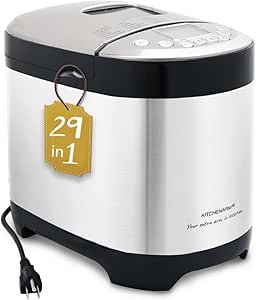
KITCHENARM 29-in-1 Smart Bread Maker, Stainless Steel
Custom cycle control is the KITCHENARM’s clearest advantage: it offers 29 menus and lets you save up to four personalized programs. That flexibility suits bakers who want to adjust steps for their own recipes, while the three loaf sizes make it easier to scale from a small loaf to a 2-pound batch. Compared with the Cuisinart Convection Bread Maker, it offers more menus and saved custom cycles, but Cuisinart adds an automatic mix-in dispenser and convection baking. The KITCHENARM also covers yogurt, jam, and gluten-free baking, though menu count alone does not guarantee a better result for every recipe. Its Teflon-coated pan may not suit buyers who prefer another pan material, and its 120 V specification is intended for North American use. I’d choose it for recipe flexibility, not for automated add-ins.
Pros:- Up to four custom menus let bakers save preferred cycle settings
- Three loaf sizes and three crust settings support different batch needs
- Includes gluten-free, whole-wheat, cake, jam, and yogurt menus
- Includes a recipe book with 77 recipes
Cons:- The Teflon-coated pan may not suit buyers seeking a different pan material
- 120 V, 60 Hz specification is intended for North American use
Best for: Home bakers who want to save and repeat customized cycles across different loaf sizes
Not ideal for: Buyers who want an automatic fruit-and-nut dispenser or prefer a pan without a Teflon coating
- Automatic menus:29
- Loaf sizes:1 lb, 1.5 lb, and 2 lb
- Crust settings:Light, medium, and dark
- Delay timer:Up to 15 hours
- Custom menus:Up to 4
- Display:2.5-inch LCD
- Bread pan:Food-grade Teflon-coated nonstick
- Warranty:2 years; lifetime customer service
Our verdict“Choose the KITCHENARM if saving custom bread cycles matters more to you than automated mix-ins or convection baking.”
Zojirushi Home Bakery Supreme Breadmaker
The 2-pound rectangular loaf gives the Zojirushi Home Bakery Supreme a more traditional sandwich-bread shape than machines that make taller, smaller loaves. Its 10 programs cover bread and other kitchen tasks such as cake, jam, dough, and sourdough starter, while a quick-bake mode offers a faster route when a long cycle will not fit the schedule. Compared with the KITCHENARM 29-in-1, this model has fewer programs and no stated custom menus, so it is less suited to people who like to tailor cycles. In return, the rectangular format may be a better fit for evenly sized sandwich slices. The tradeoffs are practical: it weighs 19.5 pounds, needs hand washing, and its 13-hour timer is shorter than the 15-hour timers on the KITCHENARM and Rosewill. I’d pick it for loaf shape and straightforward presets.
Pros:- Bakes rectangular loaves up to 2 pounds
- Quick-bake mode provides a faster baking option
- Makes dough, cake, jam, and sourdough starter
- Adjustable crust color and LCD controls support straightforward operation
Cons:- At 19.5 pounds, it is cumbersome to move or store frequently
- The pan requires hand washing
- Its 13-hour timer is shorter than the 15-hour timers on several alternatives
Best for: Households that regularly make sandwich bread and prefer a full-size rectangular loaf
Not ideal for: Bakers who want saved custom cycles, a longer delay timer, or a lighter machine to move and store
- Model:BB-CEC20
- Capacity:2 pounds
- Programs:10
- Wattage:700 watts
- Timer:13 hours
- Dimensions:8.5 x 16.87 x 12.25 inches (D x W x H)
- Weight:19.5 pounds
- Warranty:1 year
Our verdict“Choose the Zojirushi Supreme if rectangular sandwich loaves matter more than extensive customization or a longer timer.”
Cuisinart Convection Bread Maker, 2 lb., Programmable, CBK-210NAS
The Cuisinart’s automatic fruit-and-nut dispenser is its most useful distinction: on compatible programs, it adds ingredients during the cycle so bakers do not need to time an addition themselves. A convection fan and three crust shades give it another point of difference, with added airflow intended to help produce consistent crust color and texture. Compared with the KBS Pro Bread Maker, it handles mix-ins automatically too, while also offering 16 programs that include gluten-free, low-carb, and sourdough starter cycles. The KBS reaches a larger 2.2-pound loaf and has a ceramic pan, so it may suit buyers focused on batch size or pan material better. Cuisinart’s dispenser only works with compatible cycles, and its custom memory stores just one program. I’d choose it when hands-off add-ins matter more than multiple saved recipes.
Pros:- Automatic dispenser adds up to 3/4 cup of mix-ins on compatible programs
- Convection baking and three crust shades provide crust control
- 16 programs include gluten-free, low-carb, and sourdough starter cycles
- 13-hour delay timer and custom memory support scheduled baking
Cons:- The dispenser operates only with compatible programs
- Only one personalized program can be stored
- Maximum loaf size is 2 pounds, below the KBS Pro’s 2.2-pound capacity
Best for: Bread makers who often add nuts or fruit and want the machine to handle ingredient timing
Not ideal for: Bakers who want multiple saved custom programs or routinely make loaves larger than 2 pounds
- Model:CBK-210NAS
- Loaf sizes:1 lb, 1.5 lb, and 2 lb
- Programs:16
- Crust shades:3
- Mix-in dispenser capacity:Up to 3/4 cup
- Delay timer:Up to 13 hours
- Weight:10.8 pounds
- Warranty:Limited 3-year warranty
Our verdict“Choose the Cuisinart if you regularly bake mix-in breads and value automatic ingredient timing over a larger loaf or several custom settings.”
Rosewill 25-in-1 Automatic Bread Maker, 2 lb Capacity
Rosewill pairs a 15-hour delay timer with a one-hour keep-warm setting, which gives scheduled baking more flexibility than the Zojirushi Supreme’s 13-hour timer. Its 25 programs cover bread and foods such as yogurt, cake, and jam, while power recovery can resume operation after an interruption of up to 40 minutes. Dual top and bottom heaters are designed for even baking, though the product details do not establish how that compares in results with the Cuisinart’s convection system. The Cuisinart is the stronger fit for automatic mix-ins; Rosewill instead focuses on schedule options and a pan described as PFAS- and BPA-free. Its capacity tops out at 2 pounds, and the listing gives no dimensions or weight, so kitchen fit and storage are harder to judge. I’d shortlist it for timer flexibility and broad everyday menus.
Pros:- 15-hour delay timer and one-hour keep-warm function support flexible timing
- 25 programs include gluten-free bread, cake, yogurt, and jam
- Power recovery can resume operation after interruptions up to 40 minutes
- Pan is described as PFAS- and BPA-free nonstick
Cons:- Maximum loaf capacity is 2 pounds
- No dimensions or weight are provided in the product data
- No automatic mix-in dispenser is listed
Best for: Busy households that want to schedule bread well ahead and use one machine for several basic recipes
Not ideal for: Buyers who need a smaller-than-2-pound loaf, a mix-in dispenser, or verified dimensions before choosing a countertop appliance
- Programs:25
- Loaf capacity:Up to 2 lb
- Power:700 W
- Heating:Dual top and bottom heaters
- Crust colors:3
- Delay timer:Up to 15 hours
- Power recovery:40 minutes
- Pan coating:PFAS- and BPA-free nonstick coating
Our verdict“Choose Rosewill if a long delay timer and broad menu selection matter more than a dispenser or clearly documented countertop footprint.”
KBS Pro Bread Maker, 2.2 lb, 17 Programs, Ceramic Pan and Automatic Nut Dispenser
Among these five machines, the KBS Pro has the largest stated loaf size: up to 2.2 pounds, compared with the 2-pound limits on the Cuisinart Convection and Rosewill. That extra capacity suits households that want a larger loaf in one cycle. It also combines a ceramic pan and paddle with an automatic stainless-steel ingredient dispenser, giving it useful baking flexibility without the KITCHENARM’s larger menu count or four saved custom cycles. Its 17 programs and one custom setting cover a range of recipes, while convection baking is listed as another feature. The drawbacks deserve attention: the product information conflicts on whether the warranty is one or two years, and it omits dimensions and weight. I’d favor it for loaf capacity and its ceramic pan, while buyers who prioritize documented specifications may prefer the Cuisinart.
Pros:- 2.2-pound maximum loaf is larger than the 2-pound limits of the Cuisinart and Rosewill
- Automatic stainless-steel dispenser handles mix-ins
- Ceramic pan and paddle are described as nonstick and easy to clean
- Offers three loaf sizes, three crust colors, and one custom setting
Cons:- Product information conflicts on whether the warranty is one or two years
- Dimensions and weight are not provided
- The 15-minute power-failure backup is shorter than Rosewill’s 40-minute recovery window
Best for: Households that want a loaf larger than 2 pounds and often bake bread with nuts or other additions
Not ideal for: Buyers who need confirmed warranty terms or machine dimensions before making a purchase
- Model:MBF-010
- Loaf sizes:1 lb, 1.5 lb, and 2.2 lb
- Programs:17 automatic programs and 1 custom setting
- Motor power:710 W
- Pan and paddle:Ceramic
- Ingredient dispenser:Automatic stainless steel
- Delay timer:15 hours
- Power failure backup:15 minutes
Our verdict“Choose the KBS Pro if you want a larger loaf and automatic mix-ins, and can accept unclear warranty and size details.”
Elite Gourmet Programmable Bread Maker, 2 lb, Mint
The Elite Gourmet EBM8103M gives home bakers useful range without the specialty controls of the Breville BBM800XL. Its 19 programs cover bread, gluten-free recipes, dough, cake, and jam, while three loaf sizes let you scale a bake for a smaller household or a family. The 15-hour delay timer helps schedule a loaf around a morning routine, and the keep-warm cycle gives some breathing room after baking. Its 2-pound ceiling is smaller than Breville’s listed 2.5-pound maximum, and the hand-wash-only care means cleanup takes more effort. I’d choose this mint model for straightforward variety and flexible timing; bakers seeking advanced customization or a larger loaf should compare other machines in the roundup.
Pros:- Nineteen programs include gluten-free, dough, cake, and jam options
- Three loaf sizes suit different household needs
- Delay timer and keep-warm cycle support flexible schedules
- Adjustable crust settings let users choose the finish
Cons:- Hand-wash-only care adds cleanup work
- Maximum loaf size is 2 pounds
Best for: Households that want several bread and dough programs, adjustable loaf sizes, and scheduled baking in a 2-pound machine
Not ideal for: Bakers who need loaves larger than 2 pounds or want dishwasher-safe cleanup
- Model:EBM8103M
- Loaf sizes:1 lb, 1.5 lb, and 2 lb
- Programs:19
- Delay timer:15 hours
- Keep warm:60 minutes
- Power:550 watts
- Dimensions:14 x 9.75 x 11 inches
- Color:Mint
Our verdict“Choose this Elite Gourmet for scheduled, varied everyday baking if its 2-pound capacity and hand-wash cleanup fit your kitchen.”
Cuisinart Compact Automatic Bread Maker, 2 lb, CBK-110
The Cuisinart CBK-110 is the space-conscious choice among these dedicated bread makers, with a footprint of 10.25 x 13.25 x 11.25 inches and a 10.75-pound listed weight. It still handles three loaf sizes, three crust shades, and 12 programs, including gluten-free and jam. A viewing window lets you check progress without opening the lid, and the paddle-removal alert helps with a step that can affect the loaf’s bottom. Compared with the 19-program Elite Gourmet EBM8103M, it offers fewer presets and a shorter delay start, but its compact form is easier to accommodate. Its dough programs need a separate baking step, and the vertical loaf shape may not suit everyone.
Pros:- Compact dimensions and relatively light listed weight
- Three loaf sizes and three crust shades
- Viewing window and paddle-removal alert aid monitoring
- Limited three-year warranty
Cons:- Dough and artisan dough cycles require a separate baking step
- Vertical loaf shape may not suit every preference
- Thirteen-hour delay start is shorter than the Elite Gourmet’s 15-hour timer
Best for: Apartment cooks and small-kitchen bakers who want a dedicated bread maker with adjustable loaf sizes
Not ideal for: Bakers who want dough programs to complete baking in the machine or prefer a wider, horizontal loaf
- Model:CBK-110
- Programs:12
- Loaf sizes:1 lb, 1.5 lb, and 2 lb
- Crust shades:3
- Delay start:13 hours
- Keep warm:60 minutes
- Dimensions:10.25 x 13.25 x 11.25 inches
- Weight:10.75 lb
- Warranty:Limited 3-year warranty
Our verdict“Pick the CBK-110 if counter space matters most and you are comfortable finishing some dough recipes in a separate bake.”
Breville BBM800XL Custom Loaf Bread Maker, Brushed Stainless Steel
The Breville BBM800XL suits bakers who want to shape the process as well as choose a preset. Alongside 13 automatic programs, it has nine custom settings, three crust colors, and capacity for loaves up to 2.5 pounds—the largest stated capacity among the products in this batch. Its automatic fruit and nut dispenser adds mix-ins at the programmed point, while the collapsible paddle is designed to reduce the hole left in a finished loaf. Compared with the simpler Cuisinart CBK-110, Breville offers more control and a larger maximum loaf, but its 16.4-inch length takes more counter space and its care instructions require hand washing. The one-year limited warranty is also shorter than Cuisinart’s stated three-year coverage.
Pros:- Nine customizable settings complement 13 automatic programs
- Automatic dispenser adds fruit and nuts during the cycle
- Listed capacity reaches 2.5-pound loaves
- Collapsible paddle is designed to reduce the paddle hole
Cons:- Hand-wash-only care takes extra effort
- Long 16.4-inch dimension may challenge limited counter space
- One-year limited warranty is shorter than the Cuisinart CBK-110 warranty
Best for: Experienced home bakers who want custom cycle settings, automatic mix-in dispensing, and loaves up to 2.5 pounds
Not ideal for: Small-kitchen users or buyers who prioritize easy cleanup and a longer stated warranty
- Model:BBM800XL
- Capacity:1–2.5 lb loaves
- Automatic programs:13
- Custom settings:9
- Crust colors:3
- Power:830 watts
- Dimensions:9.6 x 16.4 x 13.3 inches
- Power interruption backup:60 minutes
- Warranty:1-year limited
Our verdict“Choose the Breville if recipe control and automatic mix-in handling matter more to you than compact size or simpler cleanup.”
Panasonic SD-R2550 Automatic Bread Maker with 20 Presets
The Panasonic SD-R2550 stands apart for its room and internal temperature sensors, which adjust resting and rising times as conditions change. That may appeal to bakers whose kitchen temperature shifts with the seasons and who want the machine to adapt its cycle. Its 20 presets cover bread, cakes, pizza and pasta dough, with gluten-free options, while manual settings allow control of kneading and fermentation. A timed dispenser handles raisins, nuts, and seeds without requiring a mid-cycle check. Compared with the Breville BBM800XL, Panasonic emphasizes sensor-guided cycles and preset breadth rather than a stated set of nine custom settings. The product data provides no capacity or dimensions, so buyers cannot compare loaf size or counter fit from these specifications.
Pros:- Sensors adjust resting and rising times for room and internal conditions
- Twenty presets include gluten-free choices and dough programs
- Timed dispenser handles raisins, nuts, and seeds
- Manual kneading and fermentation settings provide added control
Cons:- Product data does not state loaf capacity
- Product data does not provide dimensions for planning counter space
- Listed warranty is one year
Best for: Bakers in kitchens with changing room temperatures who want broad presets and sensor-adjusted cycles
Not ideal for: Buyers who need confirmed capacity and dimensions before choosing a machine for their counter or household
- Model:SD-R2550
- Presets:20
- Temperature sensing:Internal and room temperature
- Automatic dispenser:Raisins, nuts, and seeds
- Manual settings:Bread kneading, cake kneading, and bread fermentation
- Included components:Measuring cup, measuring spoon, Quick Start Guide, sourdough cup, and sourdough starter spoon
- Warranty:1 year
Our verdict“Pick the SD-R2550 if temperature sensing and varied presets are priorities and the missing capacity details do not prevent your decision.”
Cuisinart Pastafecto Pasta and Bread Dough Maker, White, PM-1
The Cuisinart Pastafecto PM-1 is a specialized pick for cooks who want fresh pasta alongside occasional bread dough. It mixes, kneads, and extrudes up to one pound of pasta in about 20 minutes, using six discs for shapes including spaghetti, rigatoni, and fettuccine. It can also mix and knead small-batch bread dough, but the supplied description does not say that it bakes bread. That makes it a different kind of tool from the Cuisinart CBK-110, which is a dedicated automatic bread maker with loaf-size and crust controls. The PM-1 makes sense when pasta is a regular goal and dough prep is a useful extra; skip it if you want a machine to take bread from ingredients through baking.
Pros:- Mixes, kneads, and extrudes pasta in about 20 minutes
- Six discs make several pasta shapes
- Can mix and knead small-batch bread dough
- Includes flour and liquid measuring cups plus storage accessories
Cons:- Pasta capacity is limited to one pound per batch
- Hand-wash-only care adds cleanup
- Bread dough function does not replace a bread-baking cycle
Best for: Home cooks who make fresh pasta regularly and want a machine that can also knead small batches of bread dough
Not ideal for: Buyers seeking an automatic bread maker that bakes complete loaves without a separate oven step
- Model:PM-1
- Capacity:16 ounces
- Power:1000 watts
- Programs:6
- Pasta discs:6
- Color:White
- Care:Hand wash only
- Warranty:Limited 3-year warranty
- BPA-free:Yes
Our verdict“Choose the Pastafecto if fresh pasta is your main goal and you only need it to prepare, rather than bake, bread dough.”
OSIPOTO 2 lb Automatic Bread Maker, 17 Programs
The OSIPOTO BM8205 suits households that want to adjust loaf size and crust without sorting through an unusually large program list. Its three loaf sizes range from 1 to 2 pounds, while 17 programs cover bread, cake, jam, and yogurt. Compared with the Elite Gourmet EBM8103B, it offers fewer presets, but the 600 W motor and listed 50 dB noise level may appeal to buyers who prioritize quieter operation. A 15-hour delay timer and one-hour keep-warm setting help fit baking around a workday or breakfast. The tradeoffs are practical: a 2-pound basic loaf takes about 3 hours 45 minutes, and overheat protection can pause baking until the machine cools. Choose it for routine flexibility; skip it if speed is your main concern.
Pros:- Three loaf sizes from 1 to 2 pounds suit different household needs.
- 17 programs cover bread and other preparations, including cake, jam, and yogurt.
- Delay timer and keep-warm function support flexible meal timing.
- Non-stick pan is designed for easier cleanup.
Cons:- A 2-pound basic loaf takes about 3 hours 45 minutes.
- Overheat protection may pause operation until the machine cools.
Best for: Households that want small or full-size loaves, adjustable crust, and varied everyday programs.
Not ideal for: Buyers who need a fast standard loaf or want baking to continue without cooling pauses.
- Capacity:Up to 2 lb
- Programs:17
- Loaf sizes:1 lb, 1.5 lb, 2 lb
- Crust settings:Light, medium, dark
- Power:600 W
- Delay timer:Up to 15 hours
- Keep warm:Up to 1 hour
- Noise level:50 dB
Our verdict“Pick the OSIPOTO BM8205 if adjustable loaf size and broad everyday programs matter more than a quick bake.”
Elite Gourmet Programmable Bread Maker, 2 lb, 19 Presets, Black
The Elite Gourmet EBM8103B is a straightforward choice for buyers who want a broad preset menu with one-touch kneading, rising, and baking. Its 19 programs include gluten-free bread, dough, cake, and jam, giving it a slight menu advantage over the 17-program OSIPOTO BM8205. Both machines handle three loaf sizes up to 2 pounds and offer crust selection, a delay timer, and keep-warm function, so the Elite’s distinction is the extra preset choice rather than a larger loaf or longer schedule window. Its 550 W rating and listed dimensions make it worth checking against available counter space before buying. The main limits are its 2-pound maximum and the footprint it still requires. It makes sense for preset-led convenience, but less so for people seeking a compact countertop appliance.
Pros:- 19 programs include gluten-free bread, dough, cake, and jam.
- Automates kneading, rising, and baking with one-touch operation.
- Three loaf sizes and three crust settings allow basic customization.
- Delay timer and keep-warm function help coordinate baking with meals.
Cons:- The maximum loaf size is 2 pounds.
- Despite its compact design, it still takes up counter space.
Best for: New bread-maker owners who want one-touch operation and presets for gluten-free bread, dough, cake, and jam.
Not ideal for: People with very limited counter space or households that need loaves larger than 2 pounds.
- Capacity:2 lb
- Programs:19
- Loaf sizes:1 lb, 1.5 lb, 2 lb
- Crust settings:Light, medium, dark
- Wattage:550 W
- Voltage:120 V
- Delay timer:15 hours
- Dimensions:9.45 x 11.89 x 13.98 in
Our verdict“Choose the Elite Gourmet if you value a wide preset menu and simple operation more than a smaller countertop footprint.”
OSIPOTO 2 lb Stainless Steel Bread Maker, 17 Programs
The OSIPOTO BM8708 offers a stainless steel finish alongside the familiar essentials: 17 programs, three loaf sizes, three crust settings, and a removable non-stick pan. It is the better fit than the OSIPOTO BM8205 for a buyer choosing by exterior style and warranty, with the BM8708 listing a two-year warranty. The BM8205, by comparison, specifies a 600 W motor and 50 dB noise level, details not provided for this model; the BM8708 lists 550 W. Both provide a 15-hour delay timer and one-hour keep-warm function, so neither has a schedule advantage on paper. Its chief drawback is limited sizing information: the exact loaf weights are not specified, despite the three-size claim. Pick it for finish and warranty; look elsewhere if precise loaf sizing is essential.
Pros:- 17 programs cover bread and other preparations such as pizza dough and jam.
- Three loaf sizes and three crust settings offer baking flexibility.
- 15-hour delay timer and one-hour keep-warm function support meal scheduling.
- Removable non-stick pan and listed two-year warranty.
Cons:- Exact measurements for the three loaf sizes are not specified.
- At 550 W, it has a lower listed wattage than the BM8205’s 600 W.
- Noise level is not specified in the product data.
Best for: Buyers who want a stainless steel bread maker with a removable non-stick pan and a stated two-year warranty.
Not ideal for: Bakers who need exact loaf-size options before purchase or want detailed noise and performance information.
- Capacity:2 lb
- Programs:17
- Loaf sizes:3; exact weights not specified
- Crust settings:Light, medium, dark
- Wattage:550 W
- Voltage:120 V
- Delay timer:15 hours
- Warranty:2 years
Our verdict“Choose the OSIPOTO BM8708 for its stainless steel finish and listed warranty if unspecified loaf sizes are acceptable.”
Zojirushi Home Bakery Virtuoso Plus Breadmaker, 2 lb, Black
The Zojirushi Home Bakery Virtuoso Plus stands apart for its baking setup: dual kneading blades and heaters are designed to work the dough thoroughly and brown the loaf evenly. Its courses also cover more specialized needs, including multigrain, whole wheat, gluten-free, salt-free, sugar-free, and vegan recipes. Compared with the 17-program OSIPOTO BM8205, the Virtuoso Plus is the more specialized choice, and its rapid course is listed at about 2 hours 25 minutes. That is quicker than the OSIPOTO’s stated 3 hours 45 minutes for a 2-pound basic loaf, though still not an instant bake. It produces rectangular loaves up to 2 pounds and has a shorter, 13-hour delay timer than the OSIPOTO. Choose it for specialty baking and its dual-blade design; skip it if you need larger loaves or a longer timer.
Pros:- Specialty courses include gluten-free, vegan, salt-free, and sugar-free options.
- Dual kneading blades are designed to knead dough thoroughly.
- Dual heaters support even baking and browning.
- Rapid course is listed at about 2 hours 25 minutes.
Cons:- Maximum loaf size is 2 pounds.
- The 13-hour delay timer is shorter than the 15-hour timers on both OSIPOTO models.
- Even the rapid course takes more than two hours.
Best for: Frequent home bakers who make specialty loaves, such as gluten-free, vegan, whole-wheat, or reduced-sugar bread.
Not ideal for: Households that need loaves larger than 2 pounds or a delay timer longer than 13 hours.
- Capacity:Up to 2 lb
- Power:700 W
- Kneading blades:2
- Delay timer:Up to 13 hours
- Crust settings:Light, medium, dark
- Loaf shape:Rectangular
- Rapid course:About 2 hours 25 minutes
- Included components:Breadmaker, baking pan, 2 kneading blades, measuring cup
Our verdict“Pick the Zojirushi Virtuoso Plus if specialty recipes and its dual-blade, dual-heater design justify a 2-pound limit and shorter timer.”
How We Picked
I compared the 14 models on the factors that shape day-to-day use: stated loaf capacity, range of programs, degree of customization, convenience features, and how clearly each machine fits a particular kitchen or baking routine. I gave weight to useful distinctions such as convection baking, specialty dough functions, compact designs, and automatic ingredient dispensing, rather than treating a long preset list as proof of better bread.
The ranking reflects how broadly useful each machine appears for its intended buyer, then how well its features justify its tradeoffs. Full-size, versatile machines rank highly for buyers seeking a primary bread maker; compact or simpler models rise for shoppers with tighter space or fewer needs. Specialty picks rank for the specific task they serve, since a pasta dough function or automatic add-in dispenser matters most to buyers who will use it. Product details here are based on the supplied model names and stated specifications; they do not imply hands-on testing.
Factors to Consider When Choosing Automatic Bread Makers
Before choosing a machine, think about how bread making fits into your kitchen and your week. A useful shortlist starts with loaf size and available space, then narrows by how much control you want and whether specialty features match recipes you actually make.
Match Loaf Capacity to How You Eat
A machine’s maximum loaf size tells you what it can bake, not what you should make every time. If your household eats bread slowly, frequent large loaves can go stale before they are finished; smaller batches or freezing portions may fit better. A larger capacity can help a busy household make fewer batches, but it can also mean a larger appliance and more counter space. Check whether the machine offers multiple loaf sizes, since that gives you more room to adjust batch size. Avoid choosing by the biggest capacity alone: the right size depends on how often you bake and how quickly you use a loaf. Also check the loaf shape if you care about sandwich slices or storage.
Choose Presets for the Recipes You Make
A high program count can sound useful, but its value depends on whether the cycles match your baking. Look for settings you will use, such as whole grain, gluten-free, dough, or rapid baking, and check whether the manual explains their ingredient requirements. Specialty cycles can change kneading and rise timing, so they may make unfamiliar recipes easier to manage. If you tend to repeat a few reliable recipes, a smaller set of clear programs may be simpler than a menu full of options. One common mistake is assuming a preset guarantees a good result with any flour or recipe. Ingredients, measuring, and room temperature still affect the loaf.
Decide How Much Control You Want
Preset cycles trade flexibility for convenience: select a program, add ingredients, and let the machine handle the sequence. Custom settings can help when you want to adjust baking stages or experiment with recipes that do not fit standard cycles. That control has a learning cost, since you may need to track results and fine-tune ingredients. Think about whether you enjoy recipe adjustments or prefer repeatable routines before paying for advanced controls. A machine can have many options yet still be awkward if the display or menu takes too much effort to use. Check whether delay timers, keep-warm functions, and cycle customization are clearly documented.
Measure Your Counter and Storage Space
Bread makers can be bulky, and their lid needs room to open as well as space around the body for ventilation. Measure the intended spot before choosing a model, then check the appliance’s height with the lid open if that information is available. Consider the weight and shape too: a machine that is hard to move may end up living on the counter. Compact models can be easier to store, though a smaller footprint does not always mean a smaller loaf capacity. Leave room to remove the bread pan safely and to clean around the machine. If you plan to store it after each bake, consider whether the machine and pan are easy to lift and handle.
Pay for Convenience Features You Will Use
Automatic ingredient dispensers can add nuts or other mix-ins at the right point in a cycle, saving you from waiting nearby to add them yourself. Convection can appeal if you want an extra baking approach, while dough programs can take kneading and rising off your hands even when you shape the final loaf yourself. These features add complexity, so decide whether they solve a real problem in your routine. A dispenser is less useful if you rarely add ingredients, and a specialty dough feature will not matter if you only bake standard sandwich loaves. Review cleaning instructions for removable parts and the pan coating before choosing. Convenience is most valuable when it removes a repeated task you would otherwise have to manage.
Check Cleaning and Recipe Support
Routine cleanup affects whether a bread maker stays in regular use. Look for a removable pan and kneading paddle, and read how the manufacturer advises cleaning the pan without damaging its coating. Small crevices around controls or dispensers can collect flour, so a simple exterior and accessible parts may be easier to maintain. Recipe support matters too: a well-explained manual can help new owners understand ingredient order, measurements, and cycle limits. Do not assume recipes transfer perfectly from one machine to another, since pan shape and cycle timing can differ. If you expect to bake specialty loaves, check that the instructions cover the ingredients and settings you plan to use.
Frequently Asked Questions
Should I choose a bread maker with more programs?
Choose by the programs you expect to use, not the total count. A broad menu can help if you plan to make different styles or use specialty cycles, but it may add little for someone who mainly bakes a standard loaf. Compare the named programs and consult the manual for what each cycle does. Also check whether the machine allows custom adjustments if you want to modify recipes. If you are new to bread making, straightforward controls and clear instructions can matter more than a long list of presets.
Will a 2-pound bread maker take up too much counter space?
Capacity alone does not tell you how much room a machine needs. Compare the appliance dimensions, lid clearance, and space needed to remove the pan with the spot where you plan to use it. Compact designs such as the Cuisinart CBK-110 may suit tighter kitchens, but check its measurements rather than relying on the word “compact.” If you will store the machine between uses, consider its weight and whether you can lift it comfortably. A large machine that stays accessible may be easier to use than one that is difficult to retrieve.
Is an automatic ingredient dispenser worth prioritizing?
It is most helpful if you regularly bake loaves with nuts, fruit, seeds, or similar additions and do not want to monitor the cycle. The KBS Pro’s stated automatic nut dispenser is a more specific convenience than a large general program list. If you mostly bake plain loaves, the dispenser may not change your routine enough to be a deciding feature. Check what ingredients the dispenser can hold and how it is cleaned. You can still add ingredients manually on many machines, though that requires attention at the right point in the cycle.
Can a bread maker handle dough if I want to shape and bake it myself?
Many bread makers include dough programs that mix and knead ingredients and allow the dough to rise before you shape it. This can be useful for rolls, pizza, or loaves that you prefer to bake in your own pan. Check the model’s program list and manual for cycle length and whether the machine handles the dough type you want. The Cuisinart Pastafecto is a more specialized choice for buyers who also want pasta dough functions. If you only want regular bread, a standard bread maker with a dough cycle may be enough.
When does a premium bread maker make sense?
A premium machine makes the most sense when you bake often and will use its added control, specialty features, or larger format. If you bake occasionally, a simpler model may cover your needs without the extra settings or counter commitment. Before stepping up, identify a feature that solves a real problem, such as custom cycles or a convection option. Also consider the time you are willing to spend learning the controls and recipes. The best fit is the machine that matches your routine, rather than the one with the most elaborate feature list.
Conclusion
For the best overall fit, I recommend the Zojirushi Home Bakery Virtuoso Plus for buyers who want a premium, full-size bread maker. For program variety, choose the KITCHENARM 29-in-1; its broad preset menu suits people who want to explore different cycles. Beginners may prefer the Cuisinart Compact CBK-110 if a compact design and straightforward everyday use matter most. For a premium feature set, the Breville Custom Loaf is the pick for buyers drawn to customization, while the Cuisinart CBK-210 is the one to examine if convection baking is high on your list. For a specific task, consider the KBS Pro for automatic nut dispensing or Cuisinart Pastafecto for pasta and bread dough. Match those roles to your recipes and available space, then choose the machine you are most likely to use regularly.
Evergreen bestsellers Picks

Philips Café Aromis Automatic Espresso Machine with LatteGo Pro Milk System

TCL 65-Inch T7 Series 4K QLED Smart Google TV, 144Hz (65T7)

Dyson W1 PencilWash Wet and Dry Cleaner with Dok Cordless Wet Floor Cleaner
As an affiliate, we earn on qualifying purchases.