This checklist is for anyone choosing coffee and beverage brewing gear for a home setup, whether you are building around espresso, pour-over, French press, or cold brew. Use it to focus on how each piece fits your routine and the equipment you already own.

Get kitchen gear delivered free with Prime
- Fast, free delivery on millions of items
- Prime Video, Amazon Music and more included
- Member-only deals all year
The sections follow the main jobs in a brewing setup: grinding beans, heating water, making espresso, steeping coffee, frothing milk, and preparing cold brew. Each pick is paired with practical considerations, while the French press section offers advice without a product pick.
Start with the brewing method you use most, then check counter space, capacity, and compatibility before adding another appliance. Treat the look-for points as a final checklist, and prioritize gear that suits your habits rather than buying every category at once.
Burr Coffee Grinder
A grinder affects how you prepare beans for the brewing methods you actually use, so begin by matching its capabilities to your routine. The SHARDOR 64mm Burr Coffee Grinder is the listed pick for this slot. Before choosing it, confirm that its adjustment range and operation suit your intended brewing styles; the product name alone does not establish which settings or features are included.
A common mistake is selecting a grinder around a single drink while expecting it to handle every method comfortably. Consider whether you need settings for espresso as well as coarser brewing, how often you will switch between them, and whether the grinder can fit your counter and storage plan. Check the product details for dimensions, bean capacity, adjustment steps, and cleaning guidance. If you already own an espresso machine, verify that the grinder can work with your preparation workflow and that the grind adjustments are suitable for your basket and beans.
Also consider who will use it and how much room you have to operate and clean it. Check the exact listing name and specifications before purchase, since the supplied pick name is truncated. Fit the grinder to your brew methods and available space before settling on the model.
What to look for:
- Adjustment range appropriate for your brewing methods
- Dimensions that fit the counter or storage space
- Bean capacity suited to how often you brew
- Clear cleaning and maintenance instructions
- Compatibility with your espresso preparation workflow, if applicable
SHARDOR 64mm Burr Coffee Grinder, Electric Espresso Coffee Grinder with 100 Grin

The SHARDOR 64mm Burr Coffee Grinder features high-precision stainless steel burrs for consistent grinding and minimal heat buildup. It offers 100 programmable grind settings, a durable die-cast aluminum housing, and anti-static technology for mess-free operation, making it suitable for various brewing methods at home or in small commercial settings.
Pros:
- Highly customizable with 100 grind settings for various brewing methods
- Durable die-cast aluminum housing ensures longevity and heat dissipation
- Anti-static technology keeps the grind area clean and mess-free
- Large hopper capacity suitable for high-volume use
Cons:
- Relatively heavy at 11.4 pounds, less portable
- Complex interface may require a learning curve for new users
- Higher price point compared to basic grinders
Best for: Home brewers choosing a burr grinder for their regular methods
Not ideal for: Anyone who cannot confirm its settings or fit from the product listing
Bottom line: Check the complete product specifications and match its adjustment range to the drinks you make most.
Electric Gooseneck Kettle
A gooseneck kettle is a focused choice for brewing routines where controlled pouring matters. The listed Fellow Stagg EKG Pro Gooseneck Electric Kettle has a 0.9 L capacity and a matte black finish in its supplied name. Think about whether that capacity suits the number of cups you usually prepare, and whether the kettle’s footprint works beside your brewer and other counter appliances.
Do not assume that the product name tells you every control, temperature setting, or compatibility detail. Review the current listing for the features you need, the kettle’s dimensions, and its care instructions. A frequent buying mistake is choosing for appearance or gooseneck shape without checking how much water the kettle holds or whether its controls fit the brewing routine. If you regularly make multiple servings, compare the stated capacity with your typical water needs; if you brew one cup at a time, make sure the kettle is comfortable to fill and handle at that scale.
Check that the power and placement requirements work in your kitchen, and leave room to lift and pour safely. Capacity and pour control should guide the decision, with the finish as a secondary preference. Confirm the full product details before purchase because the supplied name is truncated.
What to look for:
- Capacity that covers your usual number of servings
- Gooseneck spout suited to your pouring routine
- Dimensions and clearance for safe lifting and pouring
- Controls and features confirmed in the current listing
- Care instructions that fit your kitchen routine
Fellow Stagg EKG Pro Gooseneck Electric Kettle, 0.9 L, Matte Black with Walnut H

This 0.9-liter kettle has to-the-degree temperature control, a high-resolution LCD, and a gooseneck spout for a steady, controlled pour. Its features include scheduling, adjustable temperature hold, preset brewing modes, a brew stopwatch, and customizable settings.
Pros:
- To-the-degree temperature control with adjustable hold mode
- Gooseneck spout supports a slow, controlled pour
- Scheduling, preset brewing modes, and brew stopwatch
- Stainless steel body with walnut accents
Cons:
- Hand wash only
- Maximum fill line must be observed to prevent water from expelling during heating or pouring
- Plastic handle and lid pull
Best for: Brewers who want an electric gooseneck kettle for controlled pouring
Not ideal for: Households needing a larger capacity than the listed 0.9 L
Bottom line: Check the 0.9 L capacity, footprint, and listed controls against your daily brewing routine.
Espresso Machine
Espresso gear needs to fit both your preferred drinks and the space available for a more involved setup. The listed Meraki Dual Boiler Espresso Machine includes a grinder and built-in scales in its name, making it a combined machine-and-preparation pick. Verify the product listing for the exact functions, dimensions, included components, and operating requirements; the supplied name does not provide those details.
A common mistake is treating a machine with several named components as automatically compatible with every workflow. Check how its grinder is adjusted, what baskets or accessories are included, and whether its scale functions match how you prepare shots. Confirm the machine’s footprint and clearance, including room for handling the portafilter and maintaining the unit. If you already own a grinder or accessories, check whether they remain useful or whether the machine’s configuration changes your setup. Also consider how many drinks you prepare in a session and whether the machine’s stated capacity and workflow suit that pace.
Before deciding, read the full specifications and care requirements rather than inferring performance from “dual boiler.” Workflow, fit, and included parts are the practical checks that matter most. Ensure you can accommodate the machine and use its components comfortably in your kitchen.
What to look for:
- Full dimensions and required counter clearance
- Exact grinder adjustment and operation details
- Included baskets, accessories, and components
- Scale functions that suit your shot-preparation routine
- Cleaning and maintenance requirements
Meraki Dual Boiler Espresso Machine with Grinder and Built-In Scales

This semi-automatic espresso machine combines a burr grinder, built-in dose and yield scales, and independent brew and steam boilers. It features PID temperature control, a heated grouphead, a rotary pump with controlled pre-infusion, and a 58 mm portafilter for preparing espresso and steamed milk.
Pros:
- Independent boilers support simultaneous espresso extraction and milk texturing.
- Built-in scales measure coffee dose and espresso yield.
- Grinder offers 45 settings, micro-adjustment, anti-static technology, and near-zero retention.
- PID control, a heated grouphead, and controlled pre-infusion support temperature and extraction control.
Cons:
- The semi-automatic operation requires hands-on preparation and control.
- The 120-volt specification may limit compatibility in regions using different mains voltage.
Best for: Espresso drinkers seeking a machine with grinder and scales named in the pick
Not ideal for: Anyone who needs confirmed specifications before planning a tight setup
Bottom line: Review the full listing and confirm its footprint and workflow before committing counter space.
French Press
A French press is a straightforward category to shop for when you want a manual steeping method, but no product pick was supplied for this checklist. Start by choosing a capacity that matches how many servings you make at once. A press sized for a group may feel cumbersome when you usually brew a single cup, while a smaller vessel may require repeated batches. Check the stated capacity and whether it refers to water volume or a serving estimate.
Look closely at the materials, handle, lid, and plunger construction in the product details. A common mistake is judging a press only by its appearance without considering how it will be filled, poured, and cleaned. Confirm whether parts can be separated for cleaning and whether the maker gives care instructions. If replacement screens or other parts matter to you, check availability rather than assuming they are included or easy to source.
Match the press to your storage space and daily routine, including where it will sit while steeping and how you will dispose of the grounds. If you already own a grinder, consider whether its available settings suit your preferred French press preparation. Capacity, cleanup, and handling are useful priorities when comparing options; choose from verified specifications instead of relying on a product label alone.
What to look for:
- Capacity that matches your usual batch size
- Clear material and construction details
- Handle and lid that are comfortable to use
- Plunger and screen parts that can be cleaned as instructed
- Storage dimensions and any replacement-part information
Milk Frother
A milk frother is worth considering when milk-based drinks are part of your routine and you want a dedicated appliance for that task. The listed Breville BMF600XL Milk Café Frother is identified by its supplied name as a brushed stainless steel model. Confirm its current listing for capacity, controls, included parts, dimensions, and care requirements; those details are not established by the name alone.
One common mistake is choosing a frother without checking how much milk it handles per batch or how it fits the drinks you make. Compare the stated capacity with your usual serving size and number of people. Read the instructions for the types of milk or preparations it supports rather than assuming broad compatibility. Check whether the jug or other components are removable and how they should be cleaned. If you have limited counter space, take measurements and consider where the appliance will be stored between uses.
Also check how the frother fits alongside your espresso machine or other drink-making gear, including access to outlets and room to lift or pour. The finish may coordinate with a kitchen, but practical fit comes first. Serving capacity and cleanup are central checks for a frother you plan to use regularly. Confirm the full product details before deciding, since the pick name does not answer every fit question.
What to look for:
- Capacity suited to your typical drink count
- Listed preparation options and control details
- Dimensions and storage needs
- Cleaning instructions for removable components
- Placement that works with nearby brewing equipment
Breville BMF600XL Milk Café Frother – Brushed Stainless Steel

The Breville Milk Café frother uses progressive induction heating to create silky, micro‑bubbled milk for lattes, cappuccinos, chai tea and hot chocolate. It features automatic shut‑off at the selected temperature and a dishwasher‑safe jug for easy cleanup, plus interchangeable frothing discs and a measuring cap for added versatility.
Pros:
- Induction heating produces fine, creamy bubbles for premium milk texture.
- Automatic shut‑off prevents overheating and saves energy.
- Dishwasher‑safe jug makes cleaning quick and easy.
- Multiple frothing discs and measuring cap add versatility.
Cons:
- Relatively bulky footprint may take up counter space.
- Maximum capacity of only 1.6 lb limits large batches.
Best for: Households that regularly prepare milk-based drinks
Not ideal for: Anyone who cannot accommodate or clean a separate appliance
Bottom line: Check capacity, preparation options, and cleanup steps against the drinks you make.
Cold Brew Maker
Cold brew equipment should match the quantity and routine you have in mind, and the supplied pick is the Ninja DualBrew Pro Specialty Coffee Maker, model CFP301. Since the name does not specify its cold brew functions or capacity, verify the current product listing before treating it as a dedicated cold brew solution. Check which brewing modes are documented and whether they fit the cold coffee method you want.
A common mistake is assuming that a product labeled for specialty coffee will meet every cold brew preference. Confirm the actual preparation options, batch size, included components, and cleanup instructions. Consider how much coffee you make at once, whether you need a vessel that fits your refrigerator, and how you plan to store or serve the finished coffee. If you already own a brewer, compare the role this model would play in your setup rather than duplicating a function you rarely use.
Check the machine’s dimensions and clearance, and confirm the listed power and care requirements for your kitchen. If you want a particular steeping process, look for that process in the product documentation instead of inferring it from the model name. Verified cold brew modes and capacity should drive the decision. The supplied product name is complete, but its detailed specifications still need to be checked against your needs.
What to look for:
- Cold brew preparation modes explicitly listed by the manufacturer
- Batch capacity suited to your household
- Included components and their storage needs
- Dimensions and counter clearance
- Cleaning and care instructions for the selected modes
Ninja DualBrew Pro Specialty Coffee Maker (CFP301)
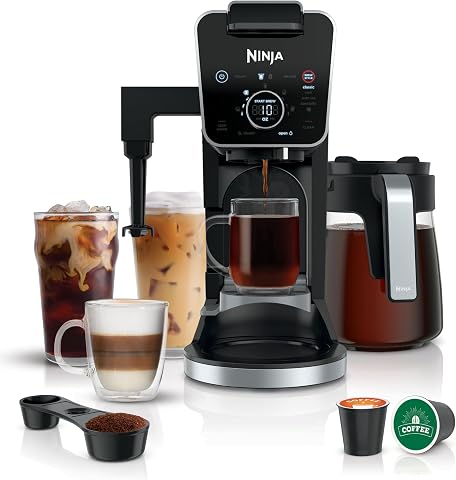
This all-in-one coffee system brews with both ground coffee and K-Cup pods, offering 13 different brew sizes and four styles including Classic, Rich, Over Ice, and Specialty. It features a built-in fold-away milk frother, an independent hot water system, and Thermal Flavor Extraction technology for precise temperature control and rich flavor.
Pros:
- Versatile brewing options for both grounds and K-Cup pods
- Includes a built-in milk frother for specialty drinks like lattes and cappuccinos
- Offers 13 different brew sizes and 4 distinct brew styles for customization
- Independent hot water system prevents cross-contamination and allows for tea or instant foods
Cons:
- Plastic exterior may feel less premium than stainless steel alternatives
- Large footprint (11.39" width) may take up significant counter space
Best for: Shoppers considering the CFP301 for a cold coffee routine
Not ideal for: Anyone needing a confirmed steeping method without checking specifications
Bottom line: Confirm that the listed brewing modes and capacity match the cold coffee you want to make.
Buy in order of daily use: start with the tool that supports your main brewing method, then add equipment that solves a recurring need. For example, prioritize a grinder for a routine that depends on freshly ground beans, or a kettle if controlled pouring is central to your setup. Check fit and compatibility before expanding into specialty appliances.
You do not need every category to make a useful coffee station. Choose carefully, verify product details, and build around the drinks you enjoy most. A setup that suits your space and routine is a good place to start, and you can add another tool when a clear need arises.