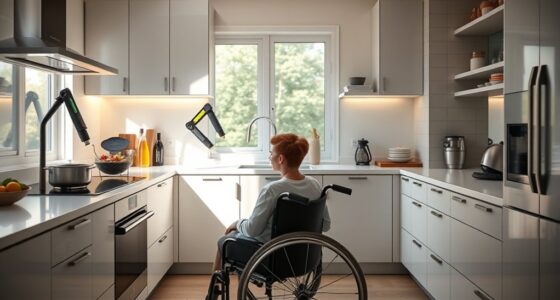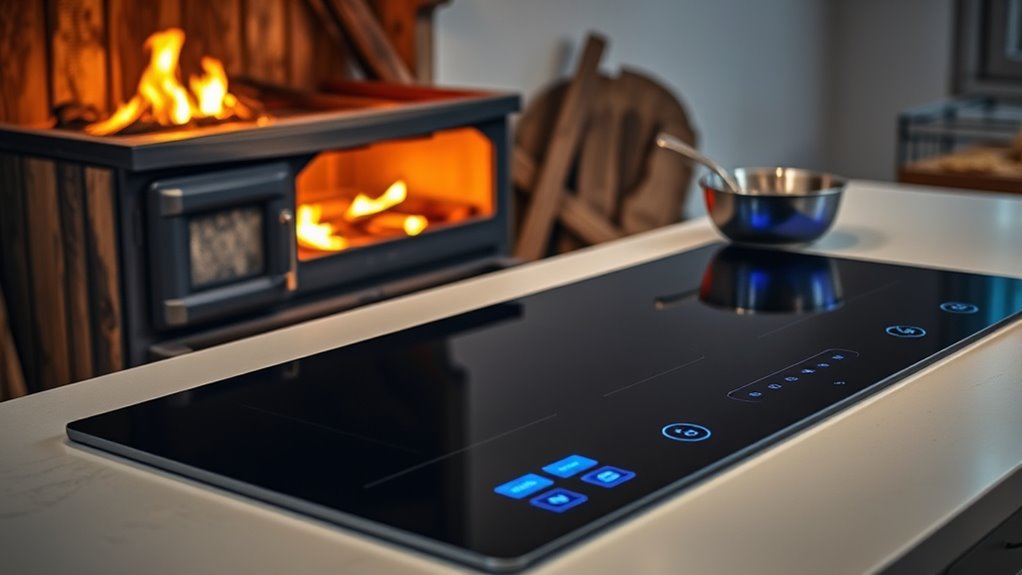

Cooking technology has evolved from simple open fires and clay pots to advanced appliances like gas and electric stoves, bringing more control and efficiency. Later, microwave ovens revolutionized speed and convenience, while smart kitchen systems now connect appliances to your devices for remote management and precise cooking. If you’re curious about how these innovations blend tradition with innovation, you’ll discover more fascinating details as you explore further.
Key Takeaways
- Cooking technology evolved from open woodfires and clay pots to sophisticated gas, electric, and microwave appliances.
- Innovations like cast iron stoves and Rumford ranges improved heat control, efficiency, and safety in home cooking.
- The 20th century saw the rise of gas and electric stoves, offering precise temperature regulation and faster meal preparation.
- Microwave ovens revolutionized cooking with rapid heating and defrosting, transforming daily meal routines.
- Modern kitchens integrate smart, connected appliances with digital controls, voice commands, and automation for enhanced convenience.
Early Beginnings: Open Fires and Earthenware

Early cooking methods relied heavily on open fires and natural heat sources, forming the foundation of culinary practices. You’d gather wood or other combustible materials and build a fire outdoors or in a simple hearth. Roasting meat on spits or boiling food in clay pots placed directly over flames became common. The development of earthenware revolutionized cooking by enabling boiling, stewing, and braising. You’d shape clay into pots, which could withstand heat and hold liquids, allowing for more varied recipes. These vessels made cooking safer and more efficient, as they protected food from direct flames and retained heat longer. Additionally, the introduction of color accuracy in early pottery decoration helped improve visual appeal and identification of food types. The durability and heat retention properties of earthenware laid the groundwork for more advanced cooking techniques that would emerge in later eras. Furthermore, the integration of natural materials in pottery design contributed to improved insulation and cooking performance, aligning with the modern emphasis on sustainability and eco-friendly decor choices.
The Dawn of Stove Innovation: From Cast Iron to Rumford’s Range
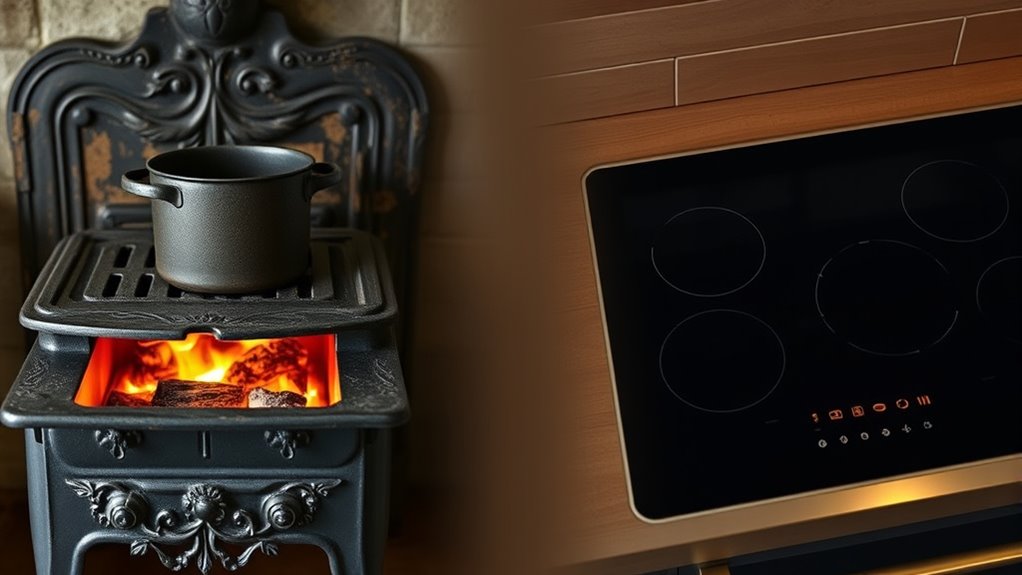
You can see how early cast iron stoves revolutionized cooking by providing more durable and efficient heat sources. Rumford’s range took this a step further with its adjustable design, allowing you to control temperature more precisely. This innovation considerably improved cooking efficiency and changed how households prepared meals. Additionally, modern home cooking technology continues to enhance convenience and safety in everyday kitchen use. Proper maintenance and hygiene are essential to keep these devices functioning safely and effectively over time.
Early Cast Iron Stoves
Cast iron stoves marked a significant breakthrough in kitchen technology, transforming the way people cooked and managed heat. These sturdy, durable appliances replaced open hearths and portable campfires, offering more consistent and controllable heat sources. In the 17th and 18th centuries, early cast iron stoves became popular across Europe and Asia, thanks to their ability to retain and distribute heat efficiently. They featured simple designs, often with a fire chamber and flat cooking surfaces. Unlike open fires, they cut down on smoke and waste, making indoor cooking cleaner. Their robustness meant they lasted for decades, and their mass production helped make indoor cooking more accessible to middle-class households. This innovation laid the groundwork for future stove enhancements and modern kitchen appliances. The development of these stoves influenced the design of subsequent modern heating devices, shaping the evolution of home heating technology. Additionally, their widespread adoption contributed to household health and safety, reducing indoor air pollution and fire hazards. Moreover, the efficiency of cast iron stoves also contributed to fuel conservation, which was especially important during periods of resource scarcity.
Rumford’s Adjustable Design
Building on the durability and improved heat management of cast iron stoves, Rumford’s adjustable design brought a new level of control to indoor cooking. He introduced a range with a damper and flue system that let you regulate airflow and heat output precisely. This innovation meant you could fine-tune the temperature without needing multiple fire sources or constant tending. Rumford’s range featured a single firebox, but with adjustable dampers, you could control the stove’s heat intensity, making cooking more consistent and efficient. This design improved safety and convenience, allowing you to better manage cooking times and temperatures. Rumford’s adjustable stove marked a significant step toward modern ranges, emphasizing user control and adaptability in the kitchen.
Impact on Cooking Efficiency
How did stove innovations from the early cast iron models to Rumford’s adjustable range transform cooking efficiency? These advancements drastically improved heat control and reduced cooking time. Early cast iron stoves provided more consistent heat compared to open fires, but lacked precise regulation. Rumford’s range introduced adjustable dampers and multiple burners, allowing you to set temperatures for different dishes simultaneously. This meant less time tending fires and more precise cooking, saving you effort and fuel. The ability to control heat levels meant better results with less waste. Over time, these innovations minimized energy loss, streamlined meal preparation, and enhanced consistency. The shift from simple heating devices to sophisticated ranges marked a significant step toward faster, more efficient home cooking.
Gas Power: Transforming Kitchen Efficiency in the 19th Century

Did you know that the advent of gas power dramatically reshaped kitchen efficiency in the 19th century? Gas stoves replaced traditional wood and coal fires, offering more precise temperature control and quicker heating. In 1802, Zachaus Winzler first used gas for cooking in England, but it wasn’t until 1834 that James Sharp introduced the first marketed gas stove. These stoves became popular because they required less maintenance and allowed you to regulate heat more accurately, making cooking faster and more consistent. Additionally, understanding the mechanics of gas burners helped households adopt safer and more efficient appliances. By the late 1800s, gas-powered appliances transformed kitchens into more efficient spaces, reducing cooking times and improving safety compared to open fires. This shift laid the foundation for future innovations, elevating household convenience and productivity.
Electric Appliances: A Safer and Faster Way to Cook
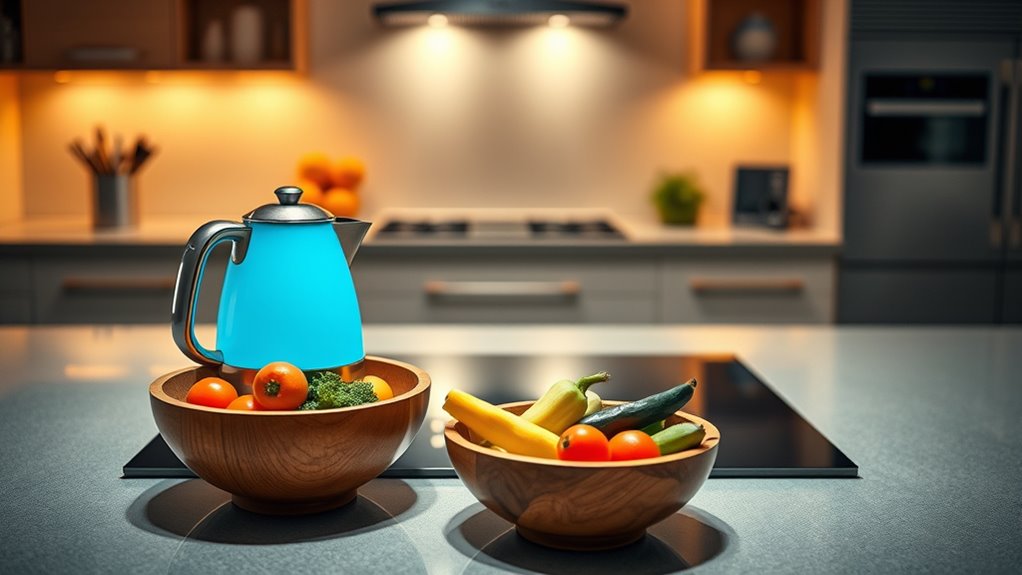
As households embraced gas stoves for their improved efficiency and safety over open fires, the next leap in kitchen technology came with the advent of electric appliances. These devices offered a safer, faster way to cook, reducing fire hazards and providing more precise temperature control. Electric ovens and toasters became household staples, streamlining meal prep. They also minimized the risk of gas leaks and explosions. Additionally, electric appliances are often more compatible with whole-home backup power systems, ensuring uninterrupted cooking during outages. Furthermore, their energy efficiency contributes to lower utility costs and a reduced environmental impact. Incorporating energy-efficient designs into these appliances further enhances their environmental benefits, making modern kitchens not only safer but more sustainable. Modern innovations like smart controls and remote monitoring also allow users to optimize energy use and cooking performance from anywhere. Advances in home automation technology now enable users to schedule and control cooking devices remotely, adding convenience and improving energy management.
Microwave Magic and Convenience Revolution
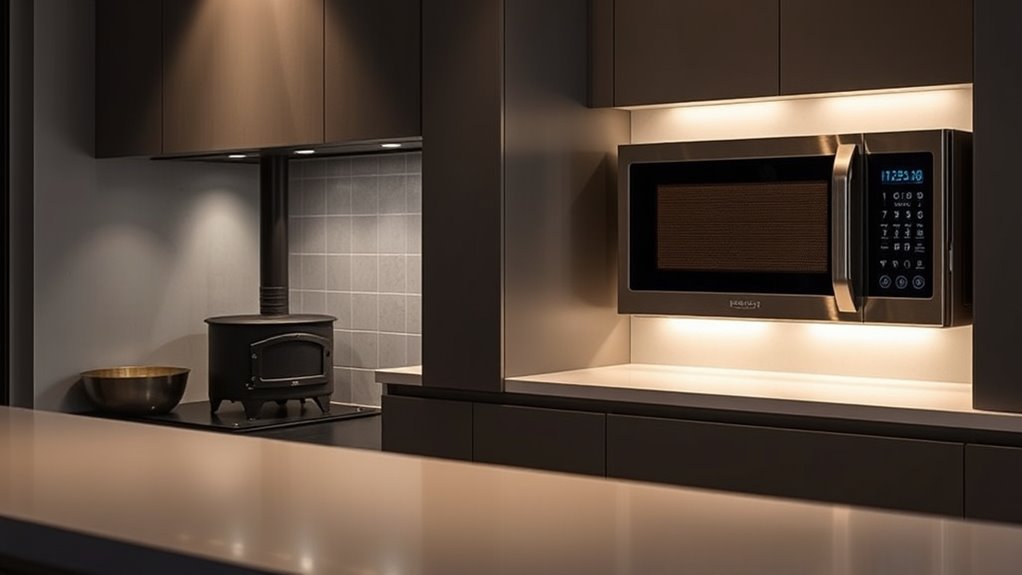
Microwave technology revolutionized your kitchen by making cooking faster and more convenient than ever before. Breakthroughs in magnetron design have boosted efficiency, allowing you to heat and cook food in minutes. Today, microwaves are essential for everyday tasks, transforming how you prepare meals with quick, reliable results. Additionally, modern microwave ovens incorporate advanced safety features to ensure safe operation during use. Enhancements in cooking technology have further expanded microwave capabilities, offering more precise control and variety of functions. As technology advances, features like smart appliance integration are increasingly common, making microwave ovens more intuitive and versatile. Recognizing the importance of sound quality and levels has also led to quieter operation, improving user experience in busy kitchens. Incorporating room‑size wattage guides helps consumers select the right microwave for their space, optimizing both performance and energy use.
Microwave Technology Breakthroughs
Have you ever wondered how microwave technology transformed everyday cooking? It all started with Percy Spencer’s accidental discovery in 1946, when a candy bar melted near a magnetron. This breakthrough led to the first commercial microwave oven in 1954, though it was bulky and expensive. By 1967, Amana introduced the Radarange, making microwaves accessible for households. These appliances revolutionized convenience, allowing you to quickly heat, defrost, and cook food with minimal effort. Over time, microwave technology advanced with improved magnetrons, better insulation, and smarter controls. Today, microwave ovens feature digital interfaces, sensors, and even smart connectivity, seamlessly fitting into modern kitchens. This evolution transformed microwave ovens from novelty gadgets into indispensable tools for fast, efficient, and reliable cooking.
Speed and Efficiency Gains
The advent of microwave technology dramatically boosted kitchen efficiency by slashing cooking and heating times. You can now prepare meals and reheat leftovers in minutes, saving you valuable time. Microwaves target water molecules inside food, rapidly converting electromagnetic energy into heat. This focused heating process is more efficient than traditional methods. To highlight this, consider the comparison below:
| Method | Average Time | Efficiency |
|---|---|---|
| Conventional Oven | 30-60 minutes | Moderate |
| Microwave | 2-10 minutes | High |
| Stovetop | 10-30 minutes | Moderate to high |
This speed and efficiency boost revolutionized home cooking, making meal prep faster and more convenient.
Everyday Kitchen Impact
Thanks to the microwave’s quick and reliable performance, your everyday kitchen routine has become more streamlined than ever. You can defrost, reheat, or cook meals in minutes, saving time and effort. Its convenience means you no longer need to wait hours for an oven or stove to heat up, making busy days easier. The microwave’s simple interface allows anyone to operate it effortlessly, reducing the need for complex cooking skills. Over the decades, its affordability and versatility have made it a staple in homes worldwide. Plus, microwave technology has evolved to include features like sensor cooking and preset programs, further simplifying meal prep. This appliance transformed how you approach daily cooking, turning it into a faster, more convenient experience without sacrificing quality.
Digital Age: From Food Processors to Smart Kitchen Systems

As technology advanced into the digital age, kitchens transformed from simple appliances into interconnected systems that enhance convenience and efficiency. You can now control and monitor your appliances remotely, thanks to smart technology. Food processors became multifunctional devices, saving time and effort in meal prep. Smart ovens and ranges connect to Wi-Fi, allowing you to set timers, adjust temperatures, and even receive cooking alerts via your smartphone. Voice assistants like Alexa or Google Home integrate seamlessly, making hands-free commands possible. Sensors track ingredient freshness and cooking progress, optimizing results. With automation and data sharing, your kitchen becomes more intuitive, reducing waste and energy use. Additionally, the integration of smart sensors allows for more precise control and customization during cooking. This integration of smart systems turns traditional cooking into a smarter, more streamlined experience, transforming your space into a connected culinary hub. Moreover, local automation can enable your kitchen devices to operate based on routines or specific triggers, further enhancing the user experience. Additionally, the incorporation of digital connectivity allows for real-time updates and customization to suit individual cooking preferences.
The Future of Cooking: Merging Tradition With Technology

Advancements in digital technology are opening new horizons where tradition and innovation blend seamlessly in the kitchen. You can now enjoy cooking experiences that honor time-tested methods while benefiting from smart features. Imagine a stove that recognizes your favorite recipes, adjusts temperatures automatically, and provides real-time feedback—all while maintaining a connection to age-old techniques like braising or roasting. Voice control, IoT integration, and AI-driven guidance make meal prep more intuitive and personalized. You don’t have to abandon traditional skills; instead, technology enhances your craftsmanship. Smart appliances can even suggest ingredient substitutions or ideal cooking times based on your preferences. This merging of old and new creates a more efficient, engaging, and meaningful cooking journey—preserving culinary heritage while embracing future innovations. Incorporating digital connectivity into your kitchen setup allows for remote monitoring and control, making the cooking process even more seamless and integrated with your smart home ecosystem.
Frequently Asked Questions
How Did Early Cooking Methods Influence Modern Culinary Techniques?
Your early cooking methods laid the foundation for modern techniques by introducing essential concepts like heat transfer, boiling, braising, and roasting. These techniques evolved as new tools and appliances emerged, allowing for more precise temperature control and diverse recipes. You now benefit from innovations like electric and microwave ovens, which build on ancient methods, making cooking faster, safer, and more efficient while expanding your culinary creativity and precision.
What Materials Were Used in the Earliest Cooking Vessels?
You’ll find that the earliest cooking vessels were mainly made from natural materials like clay and earthenware. These materials were readily available and could withstand high temperatures, making them ideal for boiling, stewing, and braising. Sometimes, you’d see stones or shells used for cooking, but clay and earthenware were most common, giving early cooks the tools they needed to prepare food over open fires.
How Did Gas Stoves Compare to Electric in Efficiency and Safety?
Gas stoves offered quicker heat control and higher efficiency compared to early electric models, making cooking more precise and faster. They were easier to repair and required less initial investment. However, safety concerns arose with gas leaks and open flames, demanding greater vigilance. Electric stoves, on the other hand, became safer over time due to enclosed heating elements and automatic shut-offs, gradually gaining popularity for their reliability and reduced hazard risks.
When Did Microwaves Become Affordable for Average Households?
Microwaves became affordable for average households in the 1980s when manufacturers like Amana released their first domestic microwave ovens, such as the Radarange. As production increased and technology advanced, prices dropped markedly. By the late 1980s and early 1990s, microwaves became common in many homes, making reheating, defrosting, and cooking quicker and more convenient for everyday use.
What Are the Key Features of Today’s Smart Kitchen Appliances?
About 85% of households now have smart kitchen appliances, making your cooking more efficient and connected. Today’s smart appliances feature voice control, remote operation via apps, and AI-powered cooking assistance. They automatically adjust temperatures, timers, and modes to optimize results. With real-time monitoring and seamless integration with other devices, you can easily customize your cooking experience, save time, and enjoy more innovative, convenient meal preparations every day.
Conclusion
You’ve seen how cooking tech has evolved from simple open fires to smart appliances. Think of it like a timeline where each innovation builds on the last, making your kitchen more efficient and connected. Just like the shift from woodfires to electric stoves revolutionized cooking, today’s smart systems promise even more personalized, seamless experiences. Embrace this journey—your kitchen’s future is about blending tradition with cutting-edge technology for better, easier cooking every day.