Current food printing tech can’t match the seamless, multi-ingredient meals of Star Trek’s replicator. It mainly assembles pre-made ingredients layer by layer and can’t create entirely new matter from energy. Recycling waste and biological items is still challenging, and safety concerns add more limits. While advances in nanotech and bioengineering are closing the gap, true replicator-like systems remain science fiction—for now. If you want to explore how close we really are, keep going.

Get kitchen gear delivered free with Prime
- Fast, free delivery on millions of items
- Prime Video, Amazon Music and more included
- Member-only deals all year
Key Takeaways
- Current food printers assemble ingredients but cannot convert raw matter into food like Star Trek’s replicators.
- Advances in nanotechnology and energy efficiency are needed to replicate complex textures, flavors, and biological items.
- Modern systems rely on pre-existing ingredients, lacking the ability to generate fresh produce or complex dishes from energy alone.
- Safety, authenticity, and ethical concerns challenge the widespread adoption of fully autonomous, replicator-like food production.
- Fully functional, seamless replicators like in sci-fi remain futuristic, with significant technological and regulatory hurdles to overcome.
Products Worth Considering

Le Creuset Enameled Cast Iron Round Dutch Oven, 5.5 Qt, Flame

De'Longhi Dinamica Plus Fully Automatic Espresso Machine

Weber Searwood 600 Wood Pellet Smoker Grill, Black
As an affiliate, we earn on qualifying purchases.
The Science Behind Star Trek’s Replicator Technology

Star Trek’s replicator technology is based on matter-energy conversion, a process that breaks down matter at the atomic level and reassembles it into desired objects. You’d supply a command, and the replicator’s advanced systems would disassemble existing matter into energy, storing it in pattern buffers. Using a matter-energy conversion matrix, it then reconstructs molecules with incredible precision, forming food, tools, or other items. This process relies on complex components like waveguides, memory storage, and power converters, often made from nitrium alloy. Significant energy input fuels this transformation, especially on starships where resource management matters. With this technology, you get instant, detailed replicas, making scarcity a thing of the past. However, safety protocols and material limits keep the process in check. Advances in European cloud infrastructure contribute to the development of secure and energy-efficient systems that could someday support similar complex processes. Additionally, ongoing research into energy-efficient computing aims to optimize these systems for broader applications beyond science fiction. As researchers explore advanced materials, the foundational technologies for replicator-like systems become increasingly feasible. Future innovations in material science could further enhance the capabilities of such complex systems.
How Modern 3D Food Printing Compares to Sci-Fi Concepts
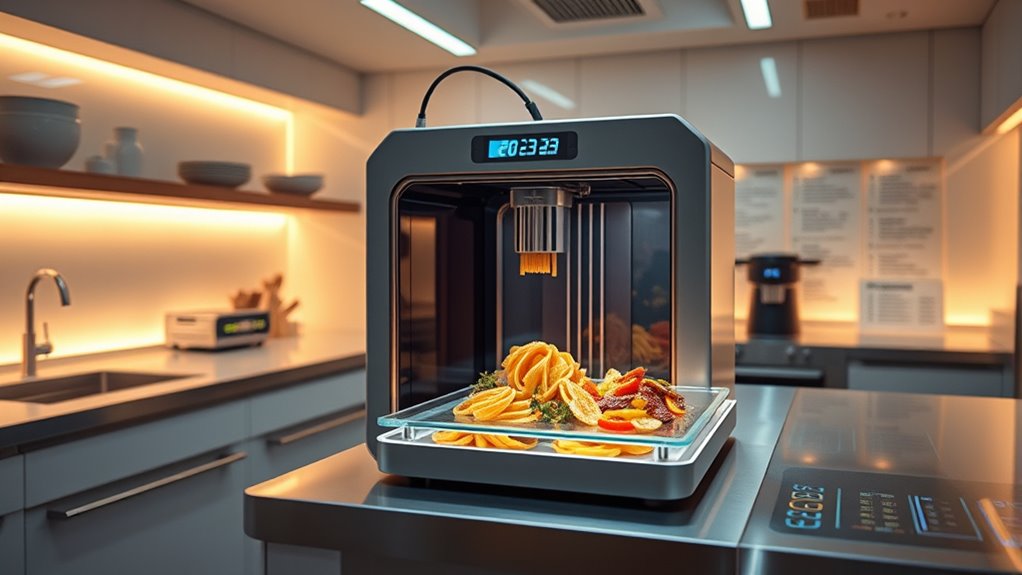
Modern 3D food printers have made significant advances but still fall far short of the capabilities depicted in science fiction. Unlike Star Trek’s replicators, they can’t convert raw matter into finished dishes from pure energy. Instead, they assemble pre-existing ingredients layer by layer, often using pastes, gels, or powders. While they can create visually appealing foods like chocolates or custom-shaped snacks, they lack the ability to produce complex, multi-ingredient meals instantly. Current technology struggles with flavor consistency, texture, and nutritional balance. They also can’t recycle waste into raw materials or generate food from biological matter. Despite these limitations, they’re useful for customizing foods and reducing waste, but they’re still a far cry from the seamless, instant food synthesis seen in sci-fi universes. Food synthesis remains a theoretical goal that could revolutionize how we approach meal preparation in the future.
Material Conversion: From Raw Ingredients to Finished Dishes

You might imagine a kitchen where energy transforms directly into any dish you want, but current technology still struggles with efficient energy-to-matter conversion. Recycling ingredients and waste is essential to minimize resource use, yet replicators in sci-fi seamlessly reuse matter without loss. Facing future challenges, we need breakthroughs to replicate complex foods and materials while managing energy demands and recycling processes effectively. Advances in Free Floating technology could potentially facilitate more efficient matter manipulation in the future.
Energy-to-Matter Transition
The energy-to-matter shift in replicator technology involves converting raw energy into complex physical objects, such as finished dishes. This process relies on matter-energy conversion, breaking down existing matter at the atomic level and reassembling it into desired forms. Using advanced pattern buffers and matter-energy conversion matrices, the system maps out precise molecular structures, reconstructing food with high fidelity. It requires significant energy input, similar to high-powered fusion reactions, to sustain the conversion process. Unlike current 3D printers, which assemble ingredients, replicators create matter from pure energy, eliminating the need for raw materials. This changeover allows instant creation of food and objects, making scarcity obsolete. However, it depends heavily on energy availability and sophisticated control systems to guarantee safety and accuracy.
Ingredient Recycling Processes
Ingredient recycling in replicator systems involves transforming used or raw materials back into their fundamental components to produce new items. This process breaks down items like dishes, packaging, or waste into basic molecules, which are then reassembled into desired objects. It creates a closed-loop resource system, reducing the need for fresh supplies. For example, dirty dishes and organic waste can be converted into raw material pools, enabling continuous production without external input. Biowaste, including human waste, likely serves as a raw source, ensuring sustainability over long voyages. This recycling capability not only minimizes resource scarcity but also helps maintain hygiene by efficiently reusing materials. While fictional replicators excel at this, current technology mainly focuses on recycling waste for compost or energy, not complete matter conversion.
Future Technological Challenges
Advancing from raw ingredients to fully prepared dishes presents significant technological hurdles, particularly in replicating the complex molecular structures and textures found in real food. To match the sensory experience, future systems must precisely manipulate molecules, replicating flavors, aromas, and textures simultaneously. Achieving this requires breakthroughs in nanotechnology and molecular engineering, which are still in early stages. Energy consumption is another challenge; replicating entire meals demands vast power sources, especially in space applications. Additionally, developing reliable safety protocols to prevent unintended reactions or contamination is critical. Integrating real-time sensory feedback will be essential for quality control. Overcoming these obstacles is vital for creating authentic, nutritious, and safe food on demand—bringing us closer to the food replication dreams of science fiction.
Limitations of Current Food Printing Technologies

Current food printers face significant challenges with energy constraints, making it hard to produce complex or large quantities of food efficiently. They’re limited by the types of ingredients they can handle and can’t create new matter from energy like sci-fi replicators do. Plus, achieving consistent textures and flavors remains difficult, often resulting in uneven or artificial-tasting dishes.
Energy Conversion Constraints
Unlike the fictional Star Trek replicator, modern food printers are limited by their inability to convert energy directly into matter. They rely on existing ingredients and raw materials, assembling them layer by layer using energy primarily for heating, cooling, and precise placement. This process requires significant energy input, but it doesn’t create new matter from scratch. Instead, it manipulates pre-existing substances, which means waste and resource constraints still exist. There’s no way to produce food from pure energy or recycle organic waste into edible items efficiently. Current technology depends on available ingredients, so it can’t generate complex nutrients or ingredients from energy alone. As a result, food production remains dependent on supply chains, limiting the possibility of instant, limitless creation like the replicators in Star Trek.
Material and Ingredient Limits
While 3D food printers can assemble ingredients layer by layer, they are fundamentally limited by the availability of pre-existing materials. These printers rely on cartridges or syringes filled with specific edible pastes, powders, or gels, which restrict the variety of foods they can produce. They can’t create new ingredients from raw elements or energy, unlike a sci-fi replicator. Complex dishes often require multiple ingredients that must be prepared separately before printing, limiting flavor and nutritional diversity. Additionally, certain materials—like some proteins or specialty items—aren’t compatible with current printers. This means you can’t simply print fresh produce, meats, or sophisticated spices on demand. Instead, you’re confined to a limited palette of available pastes and powders, constraining the range of possible foods. Moreover, the material and ingredient limits of current food printing technologies prevent the creation of entirely new or complex foods on demand. The technological constraints also mean that replicating textures and intricate culinary details remains a significant challenge with existing devices.
Texture and Flavor Uniformity
Despite advances in food printing technology, achieving consistent texture and flavor throughout printed items remains a significant challenge. Current food printers struggle to distribute ingredients evenly, often resulting in layered or uneven textures. Flavors tend to vary between bites, creating a less satisfying eating experience. For example, when printing complex desserts or layered dishes, some sections may be overly sweet or bland, disrupting the uniform taste you expect from traditional cooking. The technology’s inability to precisely control the mixing process means flavors and textures can differ from print to print or even within a single item. As a result, printed foods often lack the smooth, consistent mouthfeel you find in naturally prepared dishes. Improving this uniformity remains a key hurdle before replicators can truly mimic the seamless consistency seen in sci-fi.
Recycling and Sustainability in Replicator Systems

Recycling and sustainability are core strengths of Star Trek’s replicator technology, enabling ships to minimize waste and conserve resources. When you return used dishes or unwanted items, the replicator breaks them down into raw materials, recycling matter into new products. This closed-loop system reduces the need for additional resource extraction, helping ships operate efficiently during long missions. It likely processes biowaste and organic matter, converting waste into energy or raw ingredients for future replication. This sustainability approach guarantees minimal environmental impact, aligning with Starfleet’s resource-conscious ethos. Unlike current technology, which struggles to recycle waste into consumables, Star Trek’s replicators seamlessly reuse matter, making scarcity a thing of the past. This continuous recycling capability underpins the replicator’s role as a self-sustaining, eco-friendly system in space exploration. Additionally, ongoing advancements in waste-to-resource conversion could further enhance the efficiency and environmental benefits of future replicator systems.
The Role of Energy in Replicator Functionality
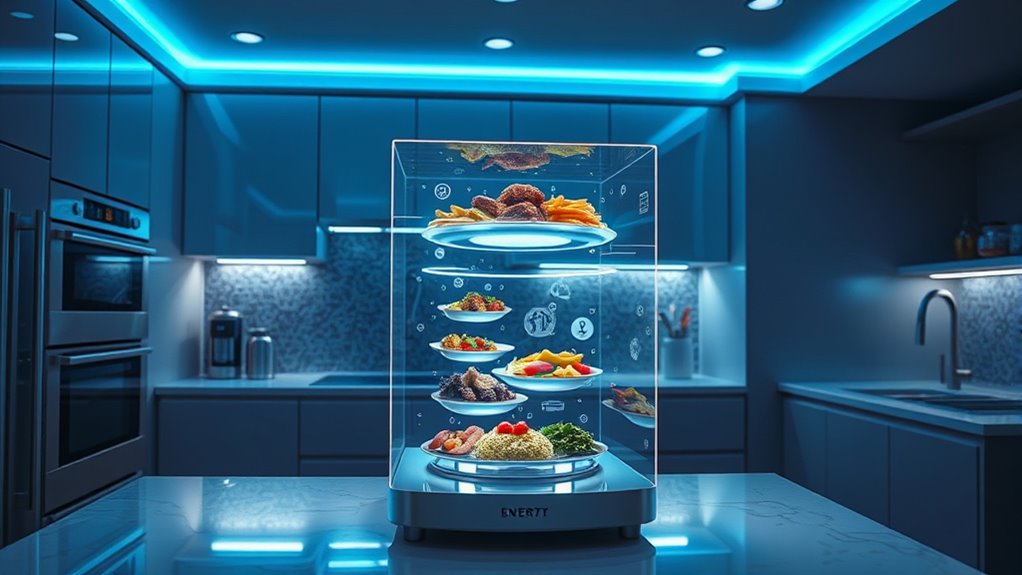
Energy is the driving force behind the replicator’s ability to transform raw matter into desired objects, including food, tools, or spare parts. It powers the matter-energy conversion process, breaking down existing materials into their atomic components and reassembling them according to specific patterns. Without sufficient energy, the replicator can’t function, which is why ships like the Enterprise dedicate significant power to their systems. The technology relies on advanced power converters, waveguides, and memory storage to manage energy flow efficiently. As you request an item, the replicator channels energy into the matter-energy matrix, ensuring molecules are reconstructed with high fidelity. This energy dependency highlights both the replicator’s sophistication and its limitations, especially during power shortages, which can restrict its ability to produce anything beyond basic needs. Additionally, understanding Youngster Choice can shed light on how individual capabilities and innovations influence technological development and resource management in future scenarios. Moreover, researchers are exploring energy efficiency improvements to extend the replicator’s operational capabilities under constrained power conditions.
Biological Item Replication: Possibilities and Challenges

While replicators excel at creating food, tools, and basic materials, reproducing complex biological items presents a different set of challenges. Biological tissues and organs have intricate structures, genetic information, and cellular functions that are difficult to replicate accurately. Current technology struggles to produce living tissues with proper vascularization, cell differentiation, and functionality. You’d need precise control over molecular assembly to recreate organs or neural tissues, which is far beyond today’s capabilities. Furthermore, biological items are inherently variable and sensitive to environmental factors, making consistent reproduction problematic. Ethical concerns also arise around creating or manipulating living tissues artificially. Although advancements in bioprinting and regenerative medicine are promising, replicating complex biological items on demand remains a goal rather than a reality.
Safety Protocols and Restrictions in Real-World Food Synthesis
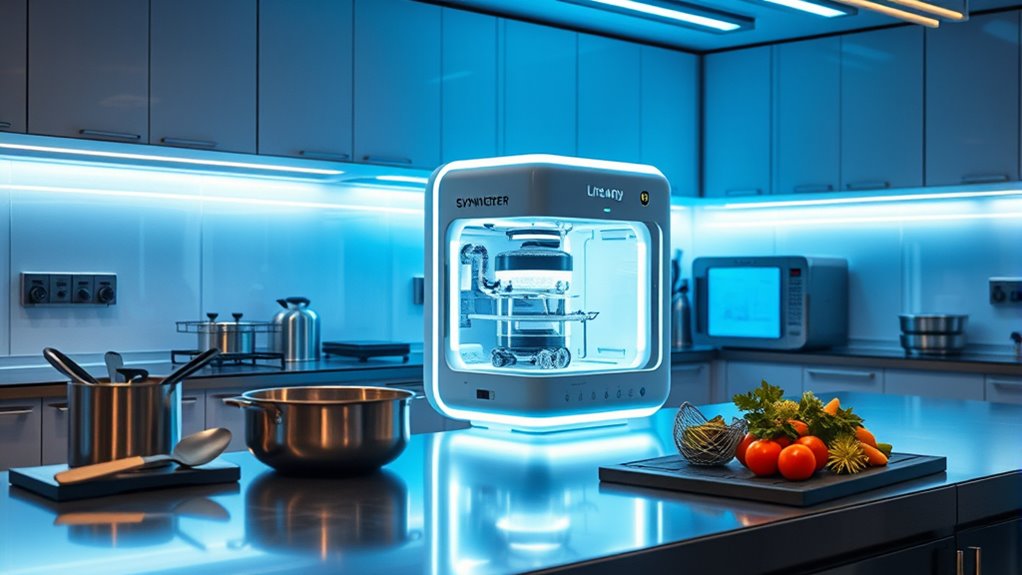
Safety protocols are essential in real-world food synthesis to prevent the production of harmful or unsafe items. Current food printers have built-in safety features that restrict the creation of dangerous substances, such as weapons, toxins, or allergens. These restrictions are programmed into the system’s software, ensuring that only approved ingredients are used. Additionally, sensors monitor temperature, contamination levels, and ingredient authenticity to avoid producing spoiled or unsafe food. Many devices also require user authentication and override protections to prevent accidental or malicious misuse. While these safety measures protect consumers, they also limit what can be created, especially when it comes to experimental or unapproved ingredients. As technology advances, safety protocols will become more sophisticated, balancing innovation with consumer protection.
Future Prospects: Bridging the Gap Between Fiction and Reality
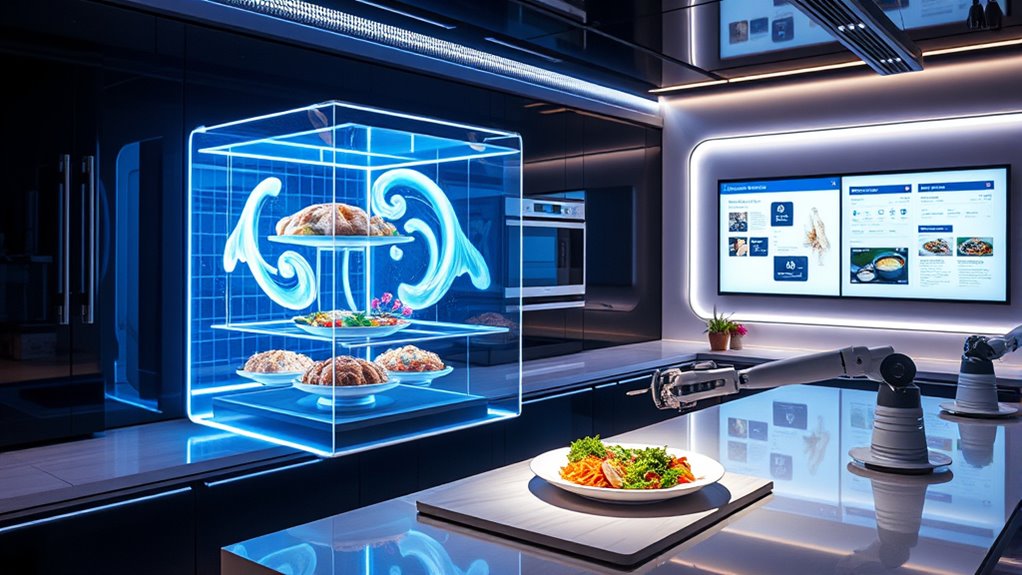
Bridging the gap between science fiction and reality in kitchen technology hinges on advances in matter-energy conversion, automation, and safety systems. While current 3D food printers can assemble ingredients, they can’t create matter from energy like Star Trek’s replicators. Future developments may focus on integrating energy-based synthesis with smarter automation, enabling real-time, on-demand food production. Enhanced safety protocols will be essential to prevent mishaps and ensure nutritional quality. Researchers are exploring bioprinting and nanotechnology to improve precision and expand material options. Although fully autonomous, energy-based replicators remain distant, incremental progress towards versatile, efficient, and safe food synthesis is promising. These innovations could eventually transform kitchens into highly adaptable, resource-efficient environments, narrowing the gap between science fiction fantasy and practical reality.
Ethical and Practical Implications of Autonomous Food Production
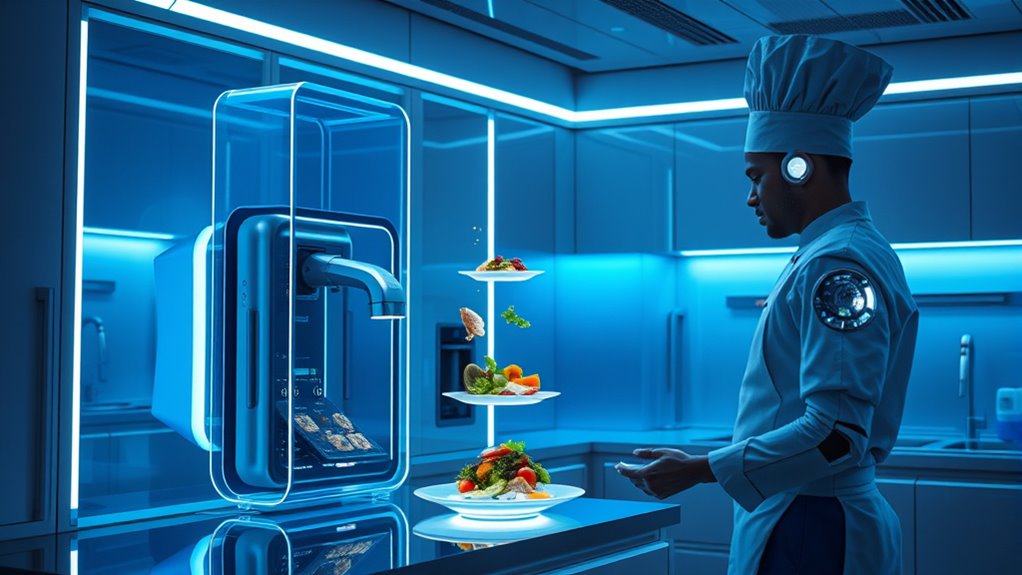
As autonomous food production becomes more advanced, you’ll need to contemplate issues like food authenticity and how you can trust what’s in your meal. Recycling waste raises ethical questions about consuming recycled organic matter, especially if it’s unclear where all raw materials originate. Additionally, the development of auditory processing technologies in food manufacturing processes sparks debate about transparency and consumer awareness. Plus, giving machines control over your food choices prompts debates about autonomy, safety, and human oversight in the kitchen. The integrity of food safety standards becomes even more critical as these technologies evolve.
Food Authenticity Concerns
The rise of autonomous food production raises significant ethical and practical concerns about authenticity and trust. You might wonder if the food you receive is truly what it claims to be or if it’s just a sophisticated illusion. Without physical ingredients or real sourcing, there’s little way to verify authenticity, making it easier to accept artificially recreated items without question. This raises questions about transparency, quality, and nutritional integrity. Are you consuming food that’s genuinely nourishing, or simply a convincing replica? Additionally, there’s the risk of tampering or misrepresentation, especially when safety protocols limit certain checks. As technology advances, maintaining trust and ensuring food authenticity will become critical to prevent deception and preserve consumer confidence in autonomous food systems. Implementing testing for allergies and verifying ingredient sources may become essential to safeguarding consumer health. Moreover, the lack of tangible sourcing information can challenge regulatory compliance, complicating efforts to ensure safety standards are met.
Waste Recycling Ethics
Autonomous food production systems that recycle waste raise important ethical questions about their impact on human dignity and environmental responsibility. You might wonder if consuming recycled organic matter devalues your meals or risks health. These systems aim to reduce waste and resource use, promoting sustainability, but they blur the line between natural and artificial. You could face dilemmas about accepting food made from biowaste or even human waste, challenging traditional notions of purity and respect for life. Here’s a quick comparison:
| Aspect | Ethical Concern | Practical Consideration |
|---|---|---|
| Waste Reprocessing | Dignity of consuming recycled matter | Food safety standards |
| Resource Circularity | Impact on environmental ethics | Efficiency & sustainability |
| Bio-waste Use | Respect for biological material | Technical feasibility |
| Food Authenticity | Perception of naturalness | Consumer acceptance |
Autonomy and Control
When machines control food production, ethical and practical concerns about autonomy and oversight come into focus. You might wonder who holds responsibility if a malfunction produces harmful food or if safety protocols are bypassed. Autonomous systems could make decisions without human input, raising questions about accountability and moral judgment. In a kitchen, oversight guarantees quality, safety, and adherence to dietary needs, but fully automated replicators challenge that control. If a machine misrepresents ingredients or causes contamination, determining liability becomes complex. Additionally, dependency on autonomous technology risks reducing human involvement in food preparation, potentially eroding skills and decision-making authority. Relying too heavily on automation could also result in regulatory challenges as governments work to establish standards and safety protocols. Striking a balance between automation’s convenience and the need for human oversight remains essential, especially when safety and ethical standards are at stake.
Frequently Asked Questions
Can Current Technology Truly Convert Energy Directly Into Edible Matter?
Currently, technology can’t truly convert energy directly into edible matter like Star Trek’s replicators. You might use 3D food printers that assemble ingredients, but they rely on pre-existing materials rather than converting energy at the atomic level. These devices can’t create food from pure energy or waste, and they lack the molecular precision of fictional replicators. So, while progress is promising, we’re still far from achieving true matter-energy conversion for food production.
What Are the Main Scientific Hurdles in Replicator-Like Food Synthesis?
You face major hurdles in replicator-like food synthesis, mainly because converting energy into complex, nutritious matter remains impossible with current science. You’d need advanced matter-energy conversion at atomic levels, which demands huge energy inputs and precise control. Additionally, replicating biological complexity, ensuring safety, and reproducing taste and texture consistently are tough challenges. Overcoming these would require breakthroughs in physics, biology, and energy technology that we haven’t yet achieved.
How Do Safety Protocols Limit Real-World Food 3D Printing Applications?
You can’t judge a book by its cover, and safety protocols in 3D food printing prove that. They restrict what you can print, preventing the creation of potentially dangerous items or contaminants. These safety measures guarantee food is safe to eat, but they also limit innovation and customization. While they protect consumers, they slow down advances, making it harder to develop fully personalized, replicator-like foods without risking health or safety.
Is Recycling Organic Waste Into New Food Feasible With Today’s Tech?
Recycling organic waste into new food is feasible today, but with limitations. You can process biowaste through composting or anaerobic digestion to produce compost or biogas, which can then support growing new crops or produce energy. However, directly converting waste into edible food via 3D printing or similar tech isn’t yet practical. Current methods require multiple steps, and food safety remains a critical concern, making it a developing but limited technology.
Could Future Innovations Enable Replicator Technology to Produce Biological Organs?
Future innovations could make replicator technology capable of producing biological organs. With advances in matter-energy conversion, bioengineering, and nanotechnology, you might see organs created on demand, tailored to individual needs. These systems would likely use detailed molecular programming and biocompatible materials, allowing for functional, safe, and personalized transplants. While still in development, such breakthroughs could revolutionize medicine, making organ shortages a thing of the past.
Conclusion
So, while sci-fi kitchens promise endless feasts at your fingertips, reality reminds you that your current oven is more “slow cooker” than starship. Don’t hold your breath for a food replicator anytime soon—unless you enjoy waiting years for a sandwich that’s still not quite right. Until then, you’ll have to settle for good old-fashioned cooking, where every burnt toast is a tiny reminder that some technologies are better left in the domain of fiction.